The questions below cover the points that most often change a placement plan: what panels can and cannot do about noise from elsewhere, where to put them, how much area to allow, how mounting changes performance, what they do for hearing protection, and what data to request from a supplier.
Does adding acoustic panels stop noise coming through a wall from the next room?
No. Decorative acoustic panels cannot block sound that passes through a wall, so they will not quiet a neighbouring room, a corridor or a plant area. Reducing that noise means changing the separating construction — its mass, its airtightness and how it is separated — and that work belongs to the partition or facade design. Panels inside your own room change how that room sounds, which is a separate problem even when both are specified together.
Should absorptive panels be placed on the ceiling or on the walls?
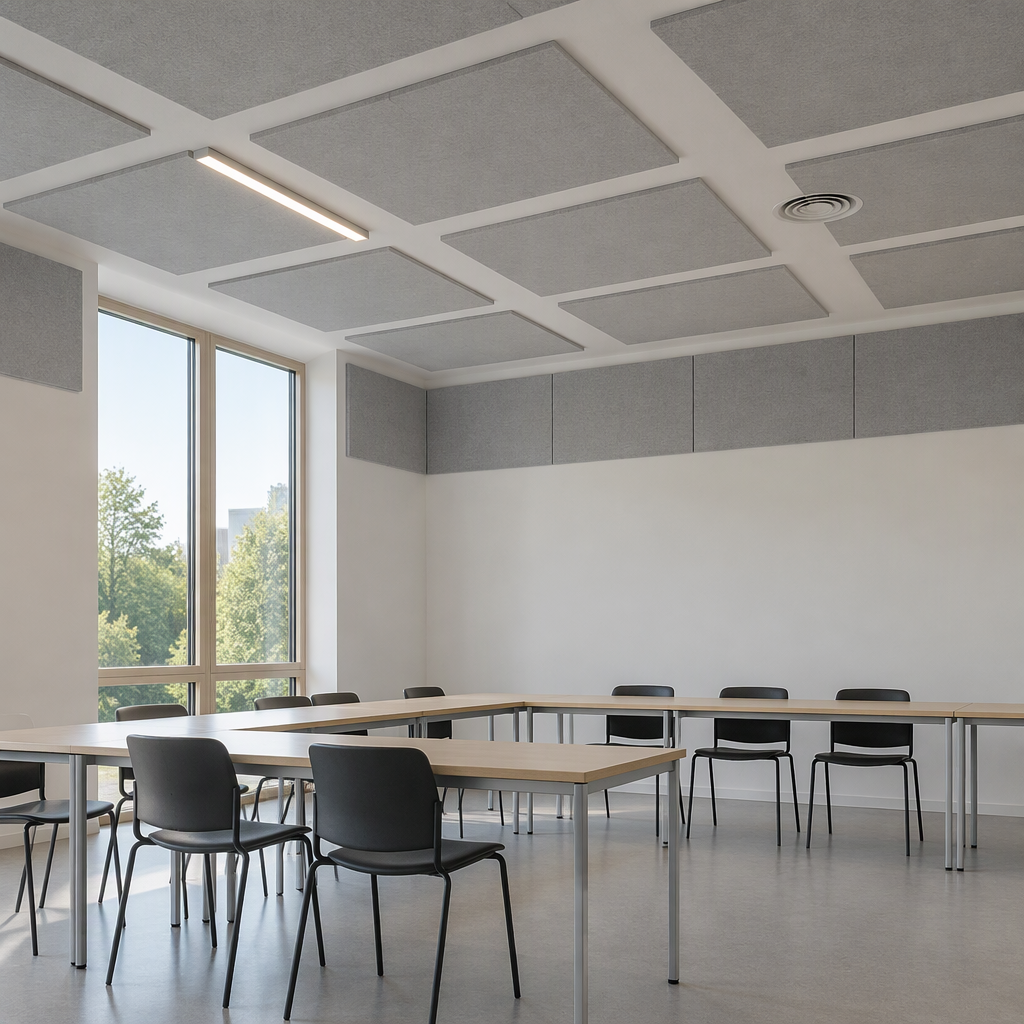
Either can work, and the deciding factors are how much usable area each plane offers, how a panel can be mounted there and where the sound is coming from. Ceilings are often the largest uninterrupted plane; upper wall bands are often simpler to fix and easier to keep out of harm's way. Because fibre structure, density and air space behind the panel change how it responds, let the mounting you can build on each plane drive the choice rather than the plane itself.
How much panel area does a reverberant room need?
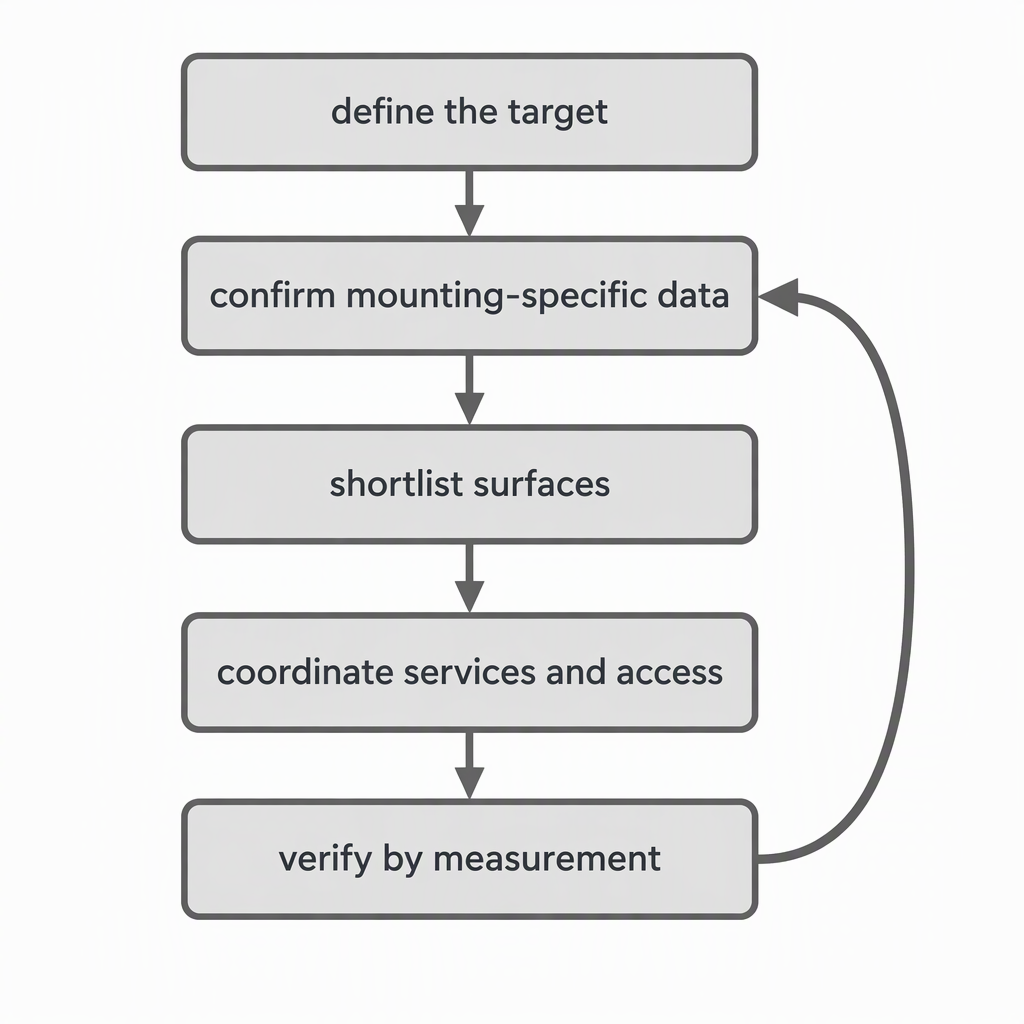
There is no universal coverage figure for acoustic panel placement. The area follows from the target, from the absorption the chosen mounting actually delivers, and from the surfaces already in the room: a panel that responds strongly to its mounting can meet the requirement with less area than one that responds weakly, and a room with large exposed hard surfaces needs more treatment than a well-furnished one. Ask the designer or supplier to size the area from the target and the mounting-specific data, and treat any figure offered without those two inputs as provisional.
Does it matter whether panels are fixed directly to the wall or mounted with an air gap?
It can change the result substantially. The air space between panel and substrate is part of the absorbing assembly, so altering it alters the panel's response across frequencies, and data measured on a direct fix does not describe a panel held off the wall. If the detail you can build includes a gap, request data measured with that gap; if you can only obtain direct-fix data, build the direct fix.
Do acoustic panels protect the hearing of workers or occupants?
Panels reduce reverberant build-up inside a room, but they are not hearing protection and no placement plan replaces a noise assessment. Hearing risk is governed by how loud the exposure is and how long it lasts: the United States National Institute for Occupational Safety and Health sets a recommended exposure limit of 85 A-weighted decibels averaged over an eight-hour working day, and recommends halving exposure duration for each 3 dBA increase in level. In Great Britain, the Control of Noise at Work Regulations 2005 require employers to assess risk at 80 dB(A), to provide hearing protection and designate hearing protection zones at 85 dB(A) daily or weekly average exposure, and never to expose workers above the 87 dB(A) exposure limit value. Where levels reach those regions, treat it as an occupational noise problem and obtain specialist advice.
What absorption data should be requested from a panel supplier before ordering?
Ask for absorption data measured for the exact mounting you intend to build, together with the standard and edition it was measured to, the mounting that was tested and a reference to the test report. It also helps to know who publishes and maintains the standards being cited; ASA Standards, for example, describes itself as an accredited standards development organization that develops national and international acoustics standards and administers United States technical advisory groups to ISO and IEC. A supplier that can name the standard and its edition is far easier to compare than one quoting a general performance claim.