



Use acoustic panels to add absorption inside the classroom when reflected sound is making speech harder to hear; do not treat them as a substitute for controlling outdoor noise, mechanical noise, or sound leakage through walls and doors. For school projects, set the acoustic target in the project brief before procurement so panel selection, installation, and verification are judged against the learning-space requirement rather than a product claim alone.
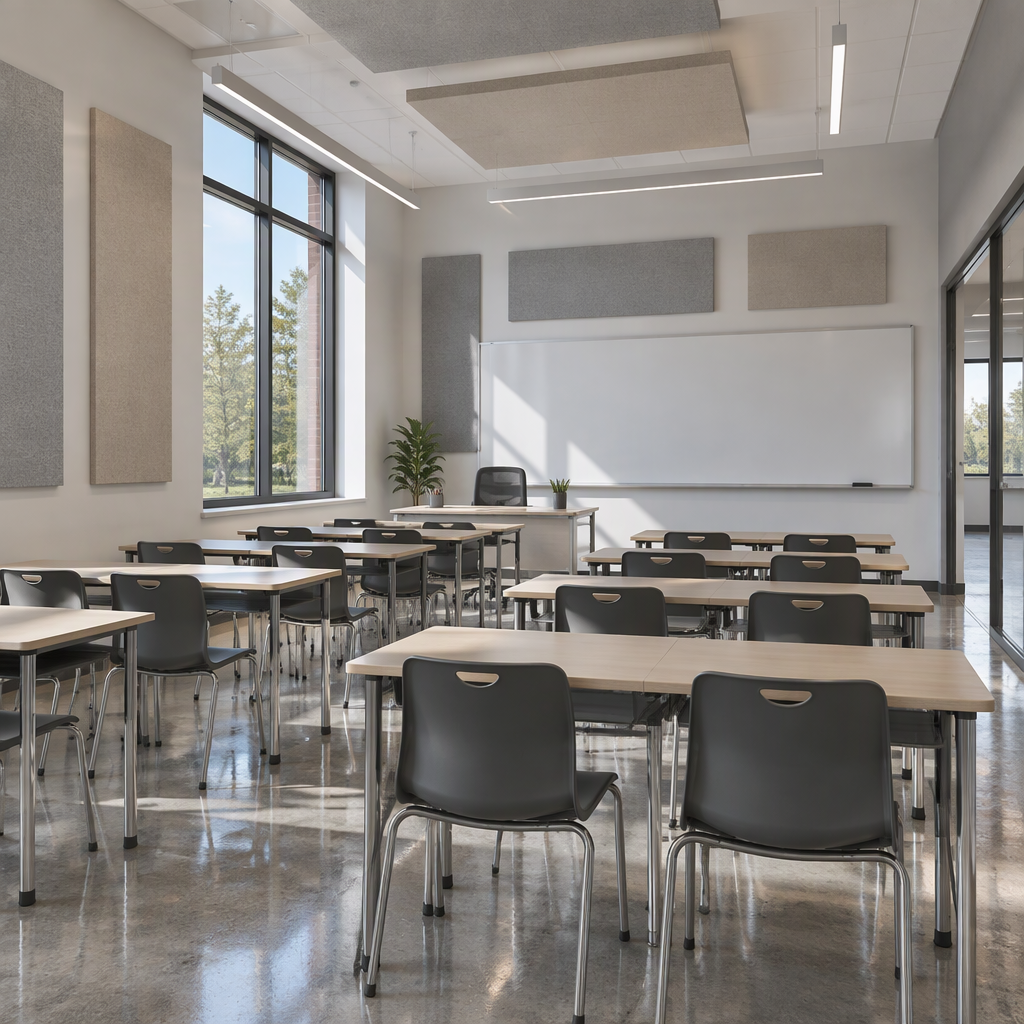
When acoustic panels help classroom reverberation
Acoustic panels are appropriate when the main problem is excessive reflected sound inside the room, especially where speech communication is important and hard surfaces leave too little absorption.
| Classroom condition | What panels can address | What to confirm before specifying |
|---|---|---|
| Speech sounds linger after the teacher or students stop speaking. | Added absorption can reduce internal reflections that contribute to reverberation. | Define the school acoustic target in the design brief and verify the current applicable standard for the project. |
| The design removes or avoids a suspended acoustic ceiling. | Lost overhead absorption should be replaced elsewhere, such as with absorptive surfaces on partitions, banners, or drapes. | Identify which surfaces are available without interfering with teaching, lighting, ventilation, cleaning, or life-safety requirements. |
| Noise comes mainly from outside, corridors, or mechanical equipment. | Panels may improve the room’s internal acoustic response, but they do not remove the source of outside or mechanical noise. | Coordinate envelope, door, partition, and mechanical-noise measures before relying on interior absorption alone. |
Absorption is not the same as sound isolation
Absorption manages reflected sound within the classroom; sound isolation addresses noise transmission from outside the room or between rooms, so the two needs should be specified separately.
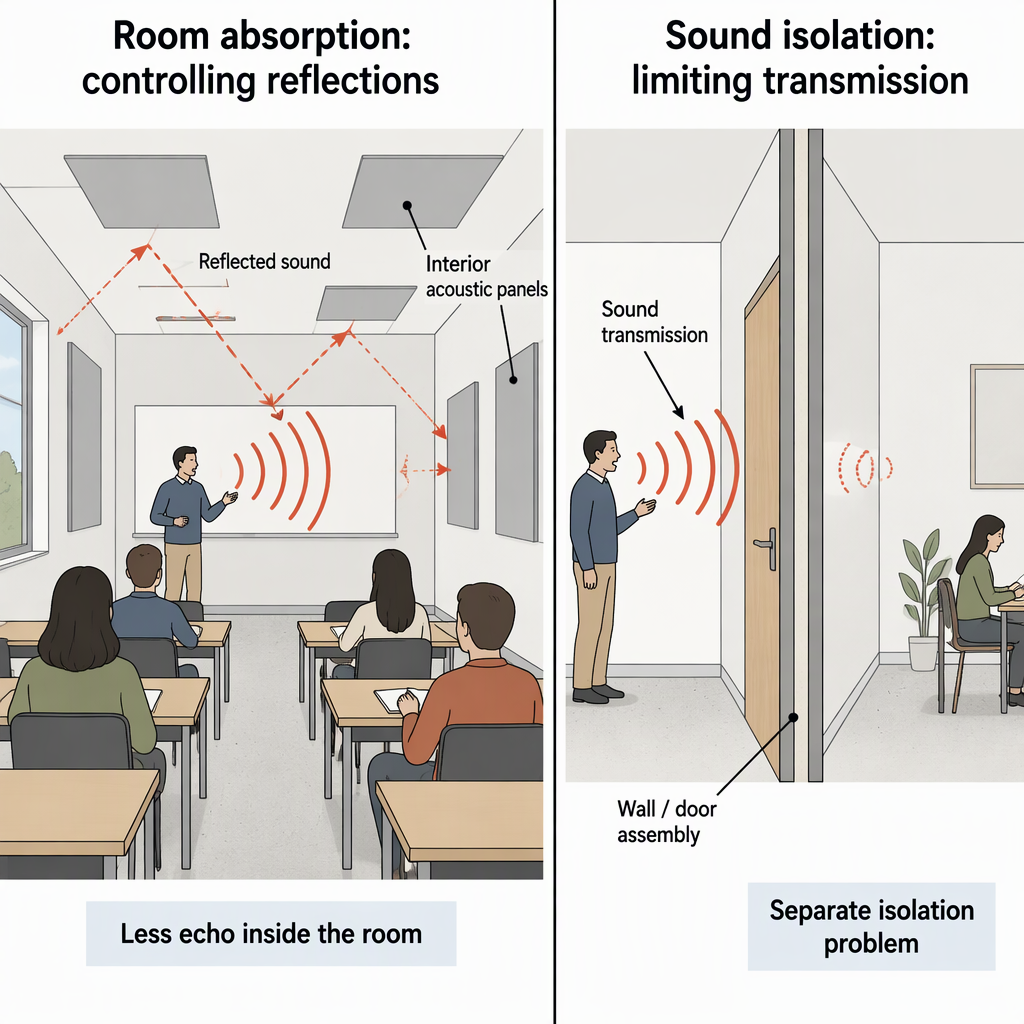
| Buyer question | Absorption treatment | Sound-isolation treatment |
|---|---|---|
| What problem is it aimed at? | Reducing room reflections and reverberation that interfere with verbal communication. | Reducing intrusion from outside noise, adjacent spaces, or building services. |
| Where is the measure usually discussed? | Inside the classroom, on available absorptive ceiling or wall areas. | At the building envelope, partitions, doors, penetrations, and mechanical systems. |
| How should procurement write the brief? | Request absorption-coefficient test data and the mounting condition used for the test. | State the external or adjacent noise problem separately so the design team can specify appropriate isolation measures. |
Room data to collect before specifying panels
Before asking for acoustic panel options, collect the room-use, surface, ceiling, and noise-source information that determines whether absorption is the primary need or only one part of the classroom acoustic strategy.
- Record the classroom use: teacher-led speech, group discussion, music, special education, lecture capture, or mixed use.
- List major hard surfaces, including exposed structure, glazing, blockwork, plasterboard, flooring, and fixed furniture.
- Confirm whether a suspended acoustic ceiling is included, removed, partially exposed, or restricted by services.
- Identify likely noise sources, including outdoor noise, corridors, mechanical equipment, and reverberation inside the room.
- State the school-acoustics standard or project acoustic brief that the finished room will be evaluated against.
- Check installation constraints such as wall impact zones, fire requirements, lighting, sprinklers, air distribution, displays, and cleaning access.
Plan placement and coverage around the missing absorption
Place panels where they replace or supplement missing absorptive area, not simply where wall space is easiest to fill.
- Start with the ceiling strategy, because removing a suspended acoustic ceiling can remove a major absorptive surface that must be replaced elsewhere.
- Map available wall and overhead areas that can accept absorptive treatment without conflicting with teaching boards, storage, windows, doors, mechanical diffusers, or life-safety devices.
- Prioritize surfaces that contribute to strong reflections in speech areas, while leaving durable finishes where students are likely to touch or damage the surface.
- Coordinate panel thickness, edge detail, fixing method, and substrate with the contractor so the installed condition matches the condition assumed in the acoustic design.
- Keep absorption planning separate from isolation work, because adding panels inside the room will not by itself solve a weak door, noisy HVAC unit, or outdoor traffic path.
Panel data to request before procurement
Ask suppliers for sound-absorption data tied to a recognized test method, plus the mounting condition and specimen description, so the design team can judge whether the data fits the classroom application.
- Request the tested sound-absorption coefficients, not only a product-family statement.
- Ask which test method, edition, specimen size, mounting condition, and airspace were used.
- Check whether the reported data describes a flat material specimen, an object, or a complete installed assembly.
- Ask the acoustic consultant to interpret laboratory data for the real classroom geometry and installed coverage.
- Require material documentation relevant to school use, including applicable fire-resistance or fire-classification information for the project jurisdiction.
Use standards as the project target, not as a marketing shortcut
For school projects, use the applicable classroom-acoustics standard or project acoustic brief to define the target; do not treat a supplier’s general statement as proof that a finished classroom will comply.
Installation and verification checks
Installation should preserve the acoustic condition assumed by the test data and design brief, and the finished room should be checked against the project target rather than judged by panel appearance alone.
- Before installation, confirm that the delivered panel type, thickness, finish, backing, and mounting condition match the data submitted for acoustic review.
- During installation, protect required building functions such as sprinklers, alarms, lighting, ventilation, access panels, and exit signage.
- Check that panels are not substituted with untested bedding foam, packing foam, or other informal absorbers.
- After installation, compare the installed coverage and mounting condition with the assumptions used when interpreting the absorption data.
- For school projects, verify the completed space against the acoustic brief or applicable school-acoustics standard using qualified measurement procedures.
Pre-RFQ checklist for classroom acoustic panels
A strong RFQ separates the classroom acoustic problem, the required evidence, and the installation conditions so suppliers can respond with comparable panel options.
- Room drawings, dimensions, ceiling strategy, and key finish materials.
- Main listening problem: reverberation, outside noise, mechanical noise, or a combination.
- Applicable acoustic brief, education standard, or consultant target for the finished classroom.
- Required absorption test data, including method, mounting condition, and specimen description.
- Fire, durability, maintenance, cleaning, and impact constraints for the school environment.
- Installation limits around services, displays, windows, doors, access panels, and student contact zones.
- A request for the supplier to state exactly which submitted data applies to the proposed installed assembly.
Conclusion
Acoustic panels are useful when the classroom needs more absorption, but the specification should also address noise sources, standards targets, material safety, and installation conditions.
The safest procurement path is to define the room problem first, request recognized absorption-test data, and have the acoustic design team interpret that data for the actual classroom before ordering panels.
FAQs about classroom reverberation panels
These questions help designers, fit-out contractors, and procurement teams keep classroom acoustic panel decisions focused on evidence and site conditions.
Can acoustic panels fix classroom reverberation?
They can help when reverberation is caused by insufficient absorption inside the classroom, but they should be part of a broader acoustic design when outside noise or mechanical equipment also affects speech communication.
Are acoustic panels the same as soundproofing?
No. Panels are mainly used to absorb reflected sound within a room, while soundproofing or isolation deals with sound passing through doors, walls, windows, ceilings, and service penetrations.
What if the classroom has an exposed ceiling?
If a suspended acoustic ceiling is removed, the lost absorption should be replaced elsewhere, such as on partitions or other suitable absorptive surfaces, subject to the room design and safety requirements.
What test data should procurement request?
Request sound-absorption coefficients measured under a recognized method such as ASTM C423, plus the mounting condition, specimen description, and any interpretation needed for the real classroom.
Which classroom acoustic standard should the brief reference?
For permanent schools in the ASA/ANSI context, ASA/ANSI S12.60-2026/Part 1 is the current announced standard; the project team should obtain the full current standard and confirm local requirements before writing the brief.
Can ordinary foam be used as a classroom absorber?
No. Classroom acoustic materials should meet applicable fire-resistance requirements, and bedding or packing foam should not be used as sound absorbers.
How should the finished room be checked?
Check the completed room against the acoustic brief or applicable school-acoustics standard, using qualified evaluation rather than relying only on the presence of panels.


