



Before specifying an acoustic panel, first match the report’s test method, specimen description, mounting condition, measured quantity, and rating method to the acoustic problem you are solving. Absorption reports such as ASTM C423 address how a material or object absorbs sound in a reverberation room; airborne sound transmission loss reports such as ASTM E90 address how building elements reduce sound passing through them; single-number ratings are summaries that need the underlying measurement context.

Separate Absorption From Sound Isolation Before Reading the Numbers
Start by deciding whether the report is about room absorption, airborne sound isolation, or a rating derived from sound transmission data; these are different acoustic questions and should not be treated as interchangeable.
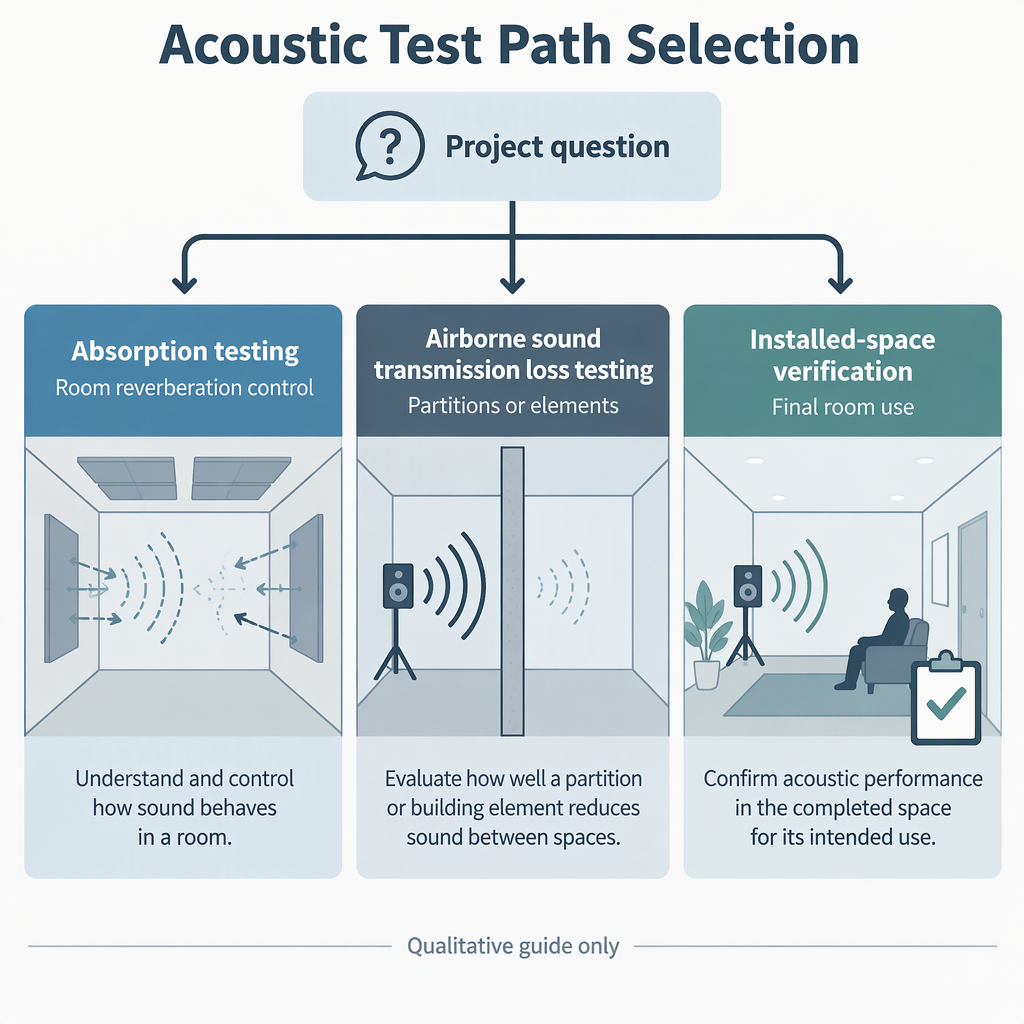
| Report focus | What it helps you decide | What to avoid assuming |
|---|---|---|
| Sound absorption measured by a reverberation-room method such as ASTM C423 | Whether the panel data is relevant to controlling reflected sound and reverberation within a room. | Do not read absorption data as proof that the panel blocks sound between rooms. |
| Airborne sound transmission loss measured by a laboratory method such as ASTM E90 | Whether an assembly or space-dividing element has laboratory transmission-loss data for sound passing through it. | Do not assume the same isolation will occur in a building where flanking paths and construction details differ. |
| Single-number sound insulation classification such as STC when derived under ASTM E413 | Whether one summary rating can support an initial comparison of sound-insulation performance. | Do not use the rating alone for every noise spectrum or project condition. |
Check Whether the Test Condition Matches the Space
A laboratory report is useful only when its specimen, mounting, and intended use resemble the way the product will be installed; laboratory absorption coefficients still require judgment when applied to practical spaces.
When reviewing an absorption report, compare the reported mounting condition, specimen configuration, and object type with the ceiling, wall, baffle, screen, or other installation planned for the project. The public ASTM C423 scope covers rooms, objects such as office screens, and absorptive material specimens, so the report’s tested configuration matters.
When reviewing an isolation report, ask whether the tested element represents the full installed assembly or only a component. Field gaps, penetrations, structure-borne paths, and adjacent construction can change the installed result even when the laboratory report is legitimate.
Request the Report Fields That Affect Specification Decisions
Do not accept a headline datasheet by itself; request the full report fields that show what was tested, how it was tested, which quantities were measured, and how any rating was calculated.
- For absorption, request the standard name and edition, specimen description, specimen quantity or tested area stated in the report, mounting condition, measured absorption coefficients, and any reported absorption summary.
- For sound isolation, request the airborne sound transmission loss method, tested assembly description, edge and mounting conditions, frequency-band transmission-loss data, and any derived single-number rating.
- For STC or similar sound-insulation ratings, request the classification method and the underlying one-third-octave sound attenuation measurements used to calculate the rating.
- For report credibility, request the laboratory name, report number, issue date, accreditation claim and scope, and enough identifying detail to confirm that the report belongs to the product or assembly being specified.
| Field to check | Why it affects approval | Buyer action |
|---|---|---|
| Test standard and edition | The method defines whether the report concerns absorption, transmission loss, or rating classification. | Match the method to the project acoustic requirement before comparing values. |
| Specimen quantity and configuration | Absorption reports are tied to tested specimens, objects, rooms, and mounting conditions. | Ask for the exact tested sample description instead of assuming all formats perform the same. |
| Rating method | Single-number ratings summarize measurement data and may not suit all noise spectra. | Keep the frequency-band data with the rating for design review. |
| Laboratory identity and competence context | ISO/IEC 17025:2017 is identified by NIST as a published standard for testing and calibration laboratory competence. | Confirm that any accreditation claim applies to the laboratory and the relevant test scope. |
Read NRC, SAA, STC, and Similar Ratings as Summaries, Not the Whole Evidence
A single-number rating can help screening, but it should not replace the test method, frequency-band data, specimen description, and installation assumptions behind the number.
For procurement, treat a headline STC or similar rating as an index into the report rather than the whole specification basis. If the room is affected by low-frequency mechanical noise, speech privacy, music, or mixed-use activity, ask the acoustic designer to review the band data and the expected noise spectrum.
For absorption reports, also look beyond the summary value. The report should show which frequencies are absorbed well, because a space with speech clarity problems may need different treatment from a space with broad reverberation control needs.
Verify the Laboratory, Report Identity, and Accreditation Scope
A credible acoustic report should be traceable to a named laboratory, a specific report identity, a relevant test scope, and a product or assembly description that matches the purchase decision.
- Check whether the laboratory identifies its competence framework; NIST lists ISO/IEC 17025:2017 as the general requirements standard for testing and calibration laboratories.
- Confirm that the report number, issue date, test date, and page count are complete and consistent across the document.
- Match the product name, material build-up, thickness, finish, backing, frame, air gap, and mounting details to the item being purchased.
- Ask for the accreditation certificate and scope when the report claims accredited testing; the scope should include the relevant acoustic method, not merely a general laboratory statement.
- Reject screenshots, cropped summary tables, or sales slides as approval evidence unless the full report can be supplied for review.
Separate Material, Equipment, and Finished-Product Verification
Separate what the material can do, what the installed system is expected to do, and what the finished space must achieve; one report rarely answers all three questions.
| Verification layer | Typical question | Report evidence to request |
|---|---|---|
| Material or acoustic panel surface | Does this panel absorb sound in the tested configuration? | Absorption coefficients and test setup from an absorption method such as ASTM C423. |
| Installation system or assembly | Does the installed build-up match the tested condition? | Mounting, backing, air cavity, object orientation, and specimen configuration stated in the report. |
| Finished partition, enclosure, or room separation | Does sound transmission through a building element need evaluation? | Laboratory airborne transmission loss data, plus project review for field flanking and construction paths. |
| Finished occupied space | Will the room meet the design intent after installation? | Design judgment that connects laboratory absorption data to room geometry, coverage, furnishings, and use. |
- Define the acoustic goal first: reverberation control, speech clarity, privacy, room-to-room isolation, or a combination.
- Use absorption reports for reflected-sound control decisions and compare the tested mounting to the intended installation.
- Use airborne sound transmission reports for partitions or elements intended to reduce sound passing through an assembly.
- Ask the acoustic designer or supplier to identify any missing evidence before the product is written into the specification.
Specification Checklist Before Approval
Approve an acoustic panel only after the report type, tested condition, measured data, rating method, laboratory identity, and project use have been checked together.
- The report standard matches the intended acoustic decision: absorption for room treatment, not sound blocking.
- Transmission-loss evidence is requested when the requirement concerns sound passing through partitions or space-dividing elements.
- The sample quantity, size, thickness, facing, backing, mounting, and air cavity are stated clearly enough to compare with the planned installation.
- Any STC or similar rating is supported by the relevant classification method and underlying frequency-band data.
- The laboratory, report number, date, and accreditation scope are traceable and relevant to the method being relied on.
- The specification notes which evidence is for material performance, which is for the installed assembly, and which must be confirmed in the finished space.
Conclusion
A useful acoustic panel test report is not just a number; it is a chain of method, specimen, mounting, measurement, rating, and intended-use evidence.
- Use absorption data for room sound control decisions and check how the tested setup compares with the installed condition.
- Use transmission-loss data when the design question is sound passing through a partition or other building element.
- Treat single-number ratings as summaries that need supporting frequency-band and classification context.
- Verify the laboratory identity and scope before relying on a report for specification.
FAQs About Acoustic Panel Test Report Interpretation
These questions help designers, contractors, and procurement teams turn an acoustic report into a specification decision.
Is an absorption report enough to prove STC performance?
No. Absorption testing addresses how sound is absorbed in a reverberation-room context, while STC is connected to airborne sound transmission loss and rating classification.
Does an old acoustic report automatically become invalid?
The issue is not age alone. Check whether the standard edition, product construction, specimen setup, laboratory identity, and current specification requirement still match the project.
What sample quantity should be accepted?
Do not assume a universal sample quantity from a sales sheet. Ask for the tested specimen quantity, area, size, configuration, and mounting condition stated in the actual report.
Can the same report cover a different mounting method?
Only if the acoustic designer accepts the difference. ASTM C423 data is tied to the tested room, object, or material specimen context, so a different mounting condition can change how the result should be used.
Is ISO/IEC 17025 accreditation proof that the product passed?
No. ISO/IEC 17025:2017 concerns testing and calibration laboratory competence; it does not by itself prove that a specific acoustic panel meets a project requirement.
When should a buyer request additional testing?
Request additional testing when the report covers the wrong acoustic question, omits specimen or mounting details, lacks underlying data for a rating, or does not match the installed assembly.
Why ask for frequency-band data if a rating is already shown?
Because single-number ratings are summaries and are not appropriate for all noise spectra; frequency-band data helps the acoustic designer judge the fit for the actual sound source.


