



Treat a VOC emissions report as evidence about one named specimen tested one way, not as a clearance for every panel of that type. US EPA has set no federally enforceable VOC limit for non-industrial interiors, so the document helps only when its specimen, method, chamber conditions, analytes and acceptance criterion can be matched to your specification. Ask for whatever is missing before the panel goes into the specification.
Where a VOC Emissions Report Fits in Acoustic Panel Selection
Volatile organic compounds are emitted as gases from certain solids and liquids, and building materials and furnishings are among the sources; indoor concentrations of many of these compounds are consistently higher than outdoor concentrations. Inadequate ventilation lets pollutants accumulate, and high temperature or humidity can increase the concentration of some of them. Preventing or minimising the indoor release of pollutants is the most effective protection, with ventilation the next step. Emissions paperwork therefore sits inside a wider indoor-air requirement for the room, not beside it.
No single figure settles the question. US EPA states that no federally enforceable standards have been set for VOCs in non-industrial settings, and its guidance on VOCs and indoor air quality points to programmes and methods instead, including the CDPH Standard Method (California Specification 01350), the California Title 17 ATCM for composite wood, ASHRAE 189.1 and CRI Green Label Plus. Whichever of those your project adopts, the report has to be read against it.
Keep the document's scope in view. An emissions report answers one chemical question about one specimen. It does not measure how a panel absorbs or insulates sound, it does not classify reaction to fire, and it does not specify how the panel should be installed. Request acoustic performance data, fire classification evidence and installation instructions as separate documents, and file the emissions report with the indoor-air submittal instead of using it to carry all three.
Material Testing Versus Finished Panel Testing
Acoustic panel VOC testing produces two different kinds of document, and the first thing to establish is which one you are holding. A material-level test speaks for the board, felt, laminate or wrap that was submitted. An assembly-level test speaks for the finished panel with its facings and adhesive, which is the item that actually arrives on site. The difference is not academic: formaldehyde release is associated with the resins used to make composite wood products and also with glues, coatings and finishes, as EPA's overview of formaldehyde sources explains, so a bare board sample does not represent a bonded assembly.
Product-scope rules follow the same logic. California's composite wood programme reaches finished goods that contain covered composite wood products, not only the panels themselves, and it links compliance to emission standards, labelling and third-party certification.
| Aspect | Material-level report | Finished-panel report |
|---|---|---|
| What is submitted | A single material: board, felt, laminate or wrap | The assembled panel, including facings, wrap and adhesive |
| What the result describes | Emissions of that material under the stated method | Emissions of the item you plan to install |
| Frequent gap | Adhesives, coatings and edge treatments sit outside the sample | Coverage depends on whether the tested build matches your drawing |
| Does it support a specification? | Useful for pre-screening a component or a supplier | Carries the requirement for the specified panel |
| What to ask for | Whether an assembly-level report exists for the same construction | Written confirmation that the tested build is the specified build |
The Report Fields That Decide Whether the Evidence Applies
You can decide most reports before reading a single number, by checking seven fields: the specimen, the sample count, the method and chamber conditions, the analytes and time points, the units, the acceptance criterion, and the issuing laboratory. If a field is missing, the report cannot yet support a requirement, so ask for the detail in writing.
- Specimen identity: exact product name, construction, thickness, core, facings and adhesive, and whether a material or an assembled panel was tested.
- Sample and specimen count: how many specimens were tested and how they were selected.
- Method: the method name and edition, chamber type and size, loading ratio, air exchange rate, temperature and humidity.
- Analytes and time points: which compounds are reported individually, such as formaldehyde, which are grouped into a total, and whether results cover one time point or a series.
- Units: stated on every figure and consistent across compounds.
- Acceptance criterion: the value or programme the result was compared against, and where that criterion comes from, because no federal limit supplies one for non-industrial interiors.
- Report integrity: issuing laboratory, report number, test dates and version, plus the certifying organisation and its number where a programme requires third-party certification.
How to Read a VOC Emissions Report, Step by Step
Work through the document in five moves: identify the specimen, check the method and chamber conditions, list the analytes with units and time points, find the acceptance criterion, then confirm who issued it and when. If one of those moves fails, stop and request the missing information before the report is used in a specification.
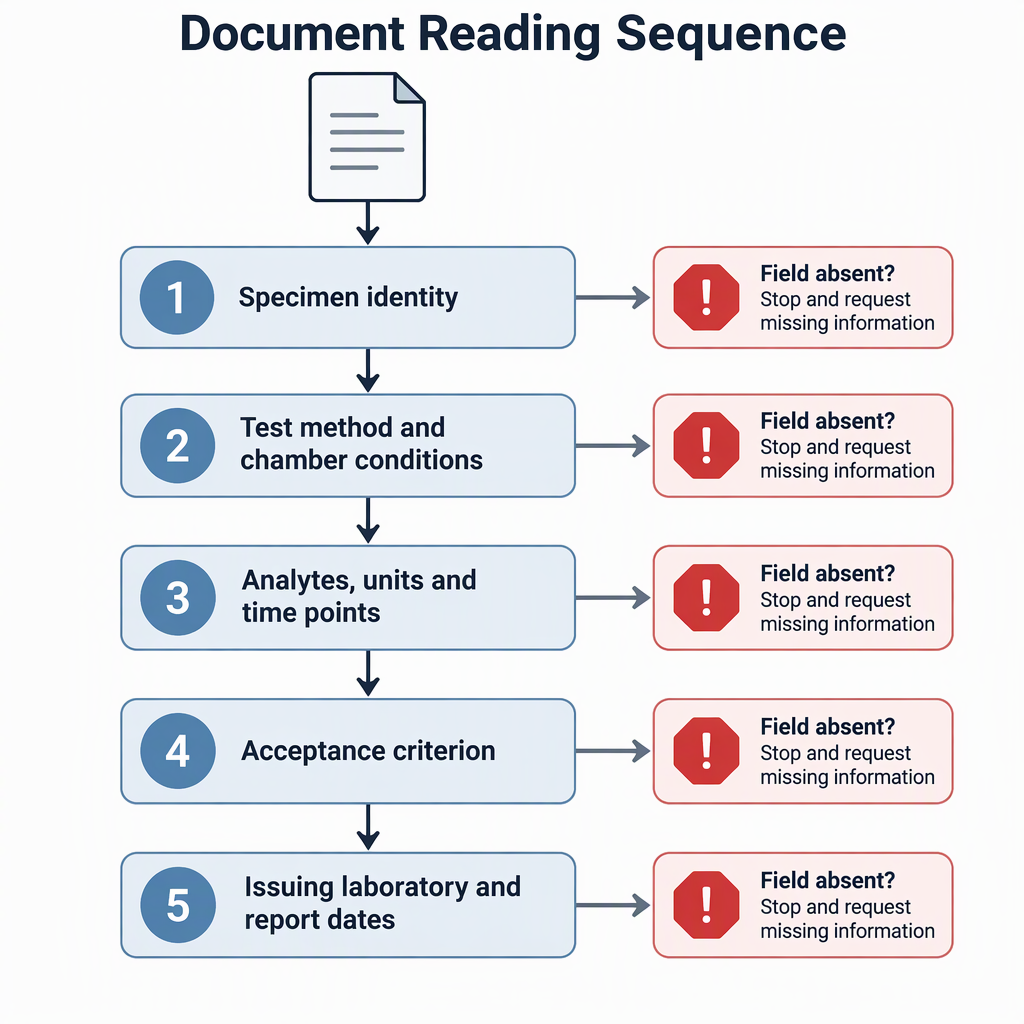
- Put the project specification beside the report. Compare the product name, construction and thickness on the report with the panel you are specifying, rather than with whatever product a supplier prefers to present.
- Identify the specimen. Note whether a material or an assembled panel was tested, and list the core, facings and adhesive the report names.
- Check the method and conditions. Record the method name and edition together with the chamber conditions, because ventilation, temperature and humidity change what the reported figures describe.
- Read the results. List each reported compound with its unit and time point, and keep individually reported compounds separate from any grouped total.
- Find the acceptance criterion, then the conclusion. Check that the criterion matches the project's requirement and that a value is printed, not only the word pass.
- Confirm the issuer, dates and version, then decide. If the composition has changed since the test, or any field is blank, treat the report as incomplete and ask for a new test.
Why Chamber Conditions and Reporting Limits Change the Answer
Two reports for similar-looking panels can disagree because emissions depend on how the test was run and what the result was compared against. Temperature, humidity and ventilation affect indoor concentrations, so figures produced under different chamber conditions are not directly interchangeable. Different chamber sizes, loading ratios, air exchange rates and time points widen the gap.
The comparison target is not universal either. With no federal VOC limit for non-industrial interiors, the criterion comes from the programme or specification your project names, and a report that does not state its criterion cannot be checked against anything.
| What you see | Why it can happen | What to ask |
|---|---|---|
| Similar panels, different values | Different method, chamber size, loading ratio, air exchange rate, temperature or humidity | Ask each laboratory for a conditions summary and compare like with like. |
| A single time point | Changes in emission over time are not shown | Ask whether a time series is available rather than one time point. |
| A pass with no value | The comparison target is not printed | Ask which criterion the result was compared against, with its edition and source. |
| Board sample, assembled panel specified | Adhesives, coatings and finishes are sources in their own right | Ask for an assembly-level report for the construction on the drawing. |
| Figures in mixed units | Conversions invite arithmetic errors | Ask for every result restated in the units your specification uses. |
What to Request From an Acoustic Panel Supplier
Put one written request to the supplier and ask for the report that matches the exact panel construction you will install, together with the detail that lets you judge it. Choosing a lower-emitting assembly at specification stage is the step you control most directly, with ventilation next; air cleaning is generally not designed to remove gaseous pollutants, so it is not a substitute. Ask for the assembly rather than the board alone, and treat adhesives, sealants and fixing materials as separate items.
- Report for the exact construction: panel family, thickness, core, facings and adhesive as they appear on the drawing.
- Assembly-level evidence: a test of the built panel, not only of a raw material sample.
- Full method detail: method name and edition, chamber type, loading ratio, air exchange rate, temperature and humidity.
- Analytes and time points with units, including formaldehyde reported individually for wood-based components, since resins, glues, coatings and finishes are formaldehyde sources.
- The acceptance criterion, its edition, and where it comes from.
- Certification where the project requires it, with the certifying organisation's name and number.
- Adhesive, sealant and fixing documentation from the same supply chain.
- Current version, report number and test date, plus written confirmation that the composition has not changed since the test.
Conclusion
Accept an emissions report for an interior acoustic panel only when four things line up: the specimen matches the panel you specify, the method and chamber conditions are stated, the analytes and time points cover the compounds your project cares about, and the comparison criterion is named and traceable. Anything else is an incomplete submittal rather than a rejection of the product.
- Specimen: material or assembly, named as it appears on the drawing.
- Method: name, edition and chamber conditions recorded.
- Results: compounds, units and time points you can compare.
- Criterion: the value your project or programme requires, with its source.
- Issuer: laboratory, report number and date, with the composition unchanged.
Frequently Asked Questions
A report is usable when its specimen, method, analytes and criterion all match your project. The answers below cover the questions buyers raise most often when they do not.
Is there one global VOC limit that an interior acoustic panel has to meet?
No. US EPA states that no federally enforceable standards have been set for VOCs in non-industrial settings and points to programmes and methods instead. Confirm the criterion your project must satisfy, usually a named programme or your own specification, in writing before you compare any result.
Does a VOC emissions report also prove the panel's sound absorption performance?
Emissions testing answers a chemical question, because volatile organic compounds are released as gases from materials. Sound absorption and sound insulation are separate performance questions with separate evidence. Request the acoustic data independently and keep both documents in the submittal.
Does California's composite wood formaldehyde rule apply to a PET acoustic panel?
The programme covers hardwood plywood, particleboard and medium-density fiberboard, plus finished goods that contain them. Polyester (PET) felt is not one of those product classes, so the rule does not target the felt itself; a composite wood core, backing or substrate in the same assembly does fall within the programme's scope. Confirm what applies to your assembly where the panels will be installed.
How should I read a formaldehyde figure next to a combined VOC figure?
As two separate results. Formaldehyde is a single compound, while a combined figure groups many. Formaldehyde is released from the resins used in composite wood products and from glues, coatings and finishes, so check the unit and time point of each figure instead of reading one as a proxy for the other.
When should I reject a VOC emissions report outright?
Hold or reject it when the specimen cannot be matched to the panel you specify, when the method or chamber conditions are missing, when no acceptance criterion is named, or when only a pass or fail word appears without the value behind it. Ask for a corrected report or a new test rather than interpreting a document that cannot support the requirement.
Do the adhesives and installation materials need to be verified separately from the panel?
Resins used to make composite wood products, and the glues, coatings and finishes applied to them, are formaldehyde sources in their own right. California's programme reaches finished goods that contain covered composite wood products. Request documentation for adhesives, sealants and substrates as separate items in the same submittal.
Who should have issued the report, and does third-party status matter?
Where a composite wood programme applies, independent certifying organisations verify producer compliance. California's programme requires third-party certification and labelling for the products it covers. Start with the laboratory that ran the test: the report should show its identity, the report number, the test dates and who commissioned it, and any certification should be checkable by organisation name and number rather than by a logo.


