



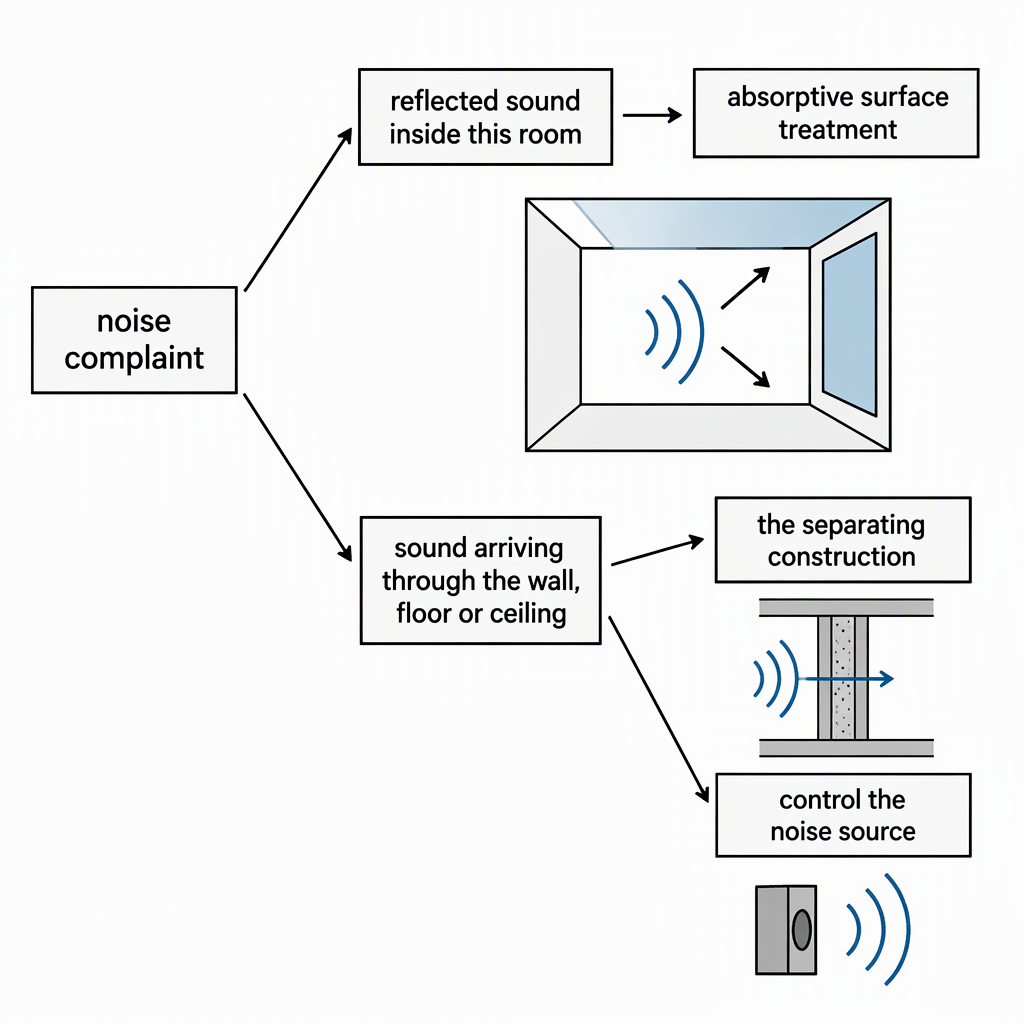
PET acoustic panels are sound absorbers: fixed to a wall or ceiling, they take up sound energy that would otherwise be reflected back into the room, which is what reduces echo and reverberation. They are not a sound barrier and will not stop noise arriving through a wall, floor, ceiling, window or door. Decide which of those two problems you have before you specify anything, because the treatment, the test data and the questions you put to a supplier are different for each.

How PET acoustic panels absorb sound
A sound absorption coefficient describes how much of the sound energy reaching a surface is absorbed rather than reflected back. ASTM C423 defines it as the fraction of randomly incident sound power taken up by the material composing the surface, which is why a panel acts on sound inside the room rather than on sound passing through the building fabric.
ASTM C423 is the reverberation-room method most often quoted for panel products: it measures how quickly sound decays in a test room and turns that decay rate into absorption coefficients for a mounted specimen. How much sound a panel takes up depends on the material and on how it is fixed, so what matters is the figure measured for the build-up you intend to install.
Treat the coefficient as a laboratory description rather than a promise for your room. ASTM C423 notes that diffraction can push measured values above unity, and that coefficients should be used with caution because installed areas are larger than the tested specimen and the sound field in a real room is rarely diffuse.
Absorption is not sound insulation
No. Absorbing sound and blocking sound are different quantities. An absorption coefficient describes how much sound energy a surface takes up inside a room; airborne sound transmission loss describes how much sound a separating construction stops from passing from one side to the other, and it is measured on that construction rather than on the panel fixed to it.
| Decision point | Sound absorption | Airborne sound insulation |
|---|---|---|
| Quantity described | Fraction of sound energy absorbed by a surface | Transmission loss of a partition or element |
| Laboratory method usually quoted | ASTM C423 reverberation-room method | ASTM E90 laboratory transmission-loss method |
| What it applies to | A specimen of absorptive material mounted for the test | The separating wall, floor or ceiling between two spaces |
| What improving it does | Less reflected sound, shorter reverberation | Less sound passing through the construction |
| What it cannot tell you | How much noise arrives from the next room | How much reflected sound your own room produces |
A laboratory transmission rating is not a prediction of isolation in a finished building. ASTM E90 states that ratings obtained by the method do not relate directly to sound isolation in buildings because flanking transmission provides other paths, and field verification uses a separate test method. When someone can hear the next room, extra absorptive area in their own room will not close that path.
How PET panel sound absorption is measured
Absorption figures come from one of two laboratory approaches: the reverberation-room method (ASTM C423), which measures how quickly sound decays in a test room, and the impedance-tube method (ASTM E1050), which measures normal-incidence coefficients for a small specimen. They are not the same measurement, so figures from the two methods are not interchangeable.
| Point of comparison | Reverberation-room method (ASTM C423) | Impedance-tube method (ASTM E1050) |
|---|---|---|
| What it determines | Sound absorption coefficients of a specimen, derived from measured decay rate | Normal-incidence sound absorption coefficients and impedance ratios |
| Specimen | A mounted specimen of absorptive material | A sample small enough to fit the tube |
| Typical use | Surface and build-up data for design and specification | Comparing absorption when a large reverberation-room sample is impractical |
| Main caution | Installed areas and real sound fields differ from the test room | Precise measurements may still mislead, and non-uniform materials must be sampled adequately |
The scope and edition of the method are published openly: the ASTM page for ASTM C423 states that it measures decay rate to determine sound absorption coefficients and lists C423-23E01 as the active edition.
The C423-06 page on the same site is labelled historical, so a report quoting that edition is quoting a superseded document rather than the current one.
Tube data also need care. ASTM E1050 is useful for comparing materials when large samples are impractical, but it warns that precise measurements may still mislead, and ASTM has since issued a 2024 edition, so ask for data to a current edition.
Decay-rate measurement is not a product rating either. ASTM E2235 covers decay rates used inside sound-insulation test methods and states it must not be used where room absorption is judged directly against a criterion such as speech intelligibility; it points users to C423 for laboratory measurement of absorption.
What to check in a PET panel test report
Read the specimen and the mounting before the number. A coefficient is only usable if the report states which standard and edition was used, what was tested, how it was fixed and how large the specimen was; without that context the figure cannot be transferred to another build-up or another room.
- The method and edition, checked against the edition the publisher currently lists as active.
- The quantity named precisely: coefficients measured in a reverberation room and normal-incidence coefficients measured in a tube are different quantities, and building-acoustics terminology is standardised separately (ASTM C634) so that the same terms carry the same meaning across test methods.
- A specimen description covering material, thickness, construction and whether the item tested was the panel alone or a complete build-up.
- The mounting condition: fixed directly, on battens, with a cavity behind, or suspended.
- Specimen area and test-room conditions, together with any statement in the report about practical areas and non-diffuse sound fields.
- The underlying measured data, not only a summary value.
- Fire documentation for the exact product and build-up, in the format the project's fire engineer accepts.
Where PET acoustic panels work best
Absorptive panels earn their place where a room's own reflected sound is the problem: hard-surfaced interiors that sound loud, harsh or tiring, and spaces where speech and equipment noise bounce between surfaces. They do not solve noise arriving through the building fabric, and they are no substitute for controlling a machine or a source outside the room.
Felt-type PET panels are most often used on the surfaces around occupied interiors. The supplier's own listings present its PET ranges - Acoustic PET Panel alongside PET ART, PET Fluting, PET Design and Wood Slat PET - under the ColorBo brand, and name application settings including office, meeting room, studio, gymnasium, ballroom and pub. Treat those settings as the intended market, and ask for the measured data that covers the range and thickness you intend to buy.
| Situation | What an absorptive surface changes | What to do first |
|---|---|---|
| Room sounds loud, echoey or tiring | Reduces reflected energy inside the room | Treat the surfaces that reflect most, and confirm the tested build-up |
| Speech is hard to follow across the room | Reduces reflected speech energy reaching listeners | Check coverage and layout before adding more area |
| You can hear the neighbouring room or corridor | Little or nothing, because the sound arrives through the construction | Review the separating wall, floor or ceiling and arrange field verification |
| Noise from a machine or plant room | Only the reflected sound in the space you are treating | Reduce or isolate the source, then treat the room |
| Open-plan speech privacy | Reduces the build-up of reflected speech | Combine with layout, screens and partition performance |
Order of attack matters more than product choice. Occupational noise guidance from NIOSH/CDC ranks controls by effectiveness, putting removal of the noise source first and reliance on personal protective equipment last. That ranking comes from workplace hearing conservation rather than from architectural acoustics, but the logic carries across: when a machine or an external source is the problem, reduce or isolate it before treating surfaces, because absorption in the room will not quiet the source itself.
Mounting and installation choices that change the result
The mounting is part of the tested product. A coefficient measured with the panel fixed directly to a hard wall describes that assembly; the same panel on battens, with a cavity behind it, or used as a suspended element is a different build-up with a different result, and a report for one arrangement should not be quoted for another.
- Ask for the tested build-up in writing: specimen description, mounting, spacer or cavity, and substrate.
- Compare that description with your designed detail, item by item.
- Where they differ, either adjust the design to the tested arrangement or ask for data covering the arrangement you want.
- Record the decision in the submittal, so the coefficient is never separated from the build-up it belongs to.
- Verify before close-up: coverage area, panel orientation, fixings, edges and penetrations match the specified arrangement.
- Keep panels clear of alarm devices, emergency signage, sprinkler heads, ventilation openings and escape routes, and confirm any deviation with the project's fire-safety adviser.
Expect site conditions to differ from the laboratory. ASTM C423 notes that installed areas are larger than the tested specimen and that a real room's sound field is rarely diffuse, so a coefficient compares options rather than predicting measured reverberation. Where a project carries a numeric acoustic target, that target needs its own design check.
Limits, fire information and verification before ordering
Before a purchase order, verify three things: the build-up the data describes matches the build-up you are buying, the fire documentation is in the form your local authority accepts, and the product data is issued by the manufacturer in writing rather than taken from a summary.
- A test report naming method, edition, specimen, mounting and specimen area.
- A statement of the tested build-up that matches the installation detail.
- Fire documentation for the exact product and build-up, with the accepted test route confirmed by the project's fire engineer for a wall lining, a ceiling and a suspended element.
- Product data: thickness, density and construction.
- Absorption data for the specific range, with the report attached.
- Cleaning and maintenance instructions issued for that product.
- Quantities, including a spare-panel allowance for future damage.
Product-specific facts are established by the manufacturer's documents for the exact item, not by a general description of PET felt. If a summary claims a fire class or an acoustic rating without naming the test method, edition and mounting, ask for the underlying report before the item goes into the submittal.
Conclusion
Decide the problem before the product. If the complaint is that a room sounds loud, echoey or hard to talk in, a tested absorptive panel is a legitimate treatment; if the complaint is noise arriving through a wall, floor, ceiling or facade, the separating construction or the noise source is where the work is.
Then specify the build-up, not just the panel, and buy on documentation: a named test method and edition, a specimen and mounting that match your detail, measured data rather than a bare figure, and fire information your local authority accepts. A supplier who can answer those questions in writing is the one to keep on the tender list.
Frequently asked questions
Most buyer questions come back to one distinction and one document: is the problem reflected sound in the room or sound arriving through the building, and does the test report describe the build-up you are actually buying. The answers below cover the questions that decide a specification.
Will PET panels stop noise coming through the wall from the next room?
No, not through that path. Absorption in your room reduces reflected sound; it does not add transmission loss to the wall, floor or ceiling separating you from the neighbour, and laboratory ratings of that construction do not translate directly because flanking paths carry sound around the element. For neighbour noise, start with the construction, not with more panels in your room.
Which test method should an absorption figure come from?
ASTM C423, the reverberation-room method, and ASTM E1050, the impedance-tube method, both produce absorption data, but not the same measurement: C423 gives coefficients for a mounted specimen; the tube gives normal-incidence coefficients for a small sample. Use the tube route to compare materials when a large sample is impractical, and expect C423-style data when the figure is meant to describe a surface as installed.
Is an older edition of an absorption test standard still acceptable?
Only if it is clearly identified as that edition, and preferably not. ASTM lists C423-23E01 as the active edition of the reverberation-room method, while the C423-06 page is labelled historical. The tube method has moved on as well, with a 2024 edition replacing the 2019 edition. Ask which edition a report used and, if it is older, request data to the current edition.
Does the mounting or an air space behind the panel change the result?
Yes. Coefficient data describe a tested specimen in a tested mounting, so a report for a directly fixed panel does not describe a wall with battens, a cavity or a suspended panel. Keep the tested build-up and your detail identical, or ask for data covering your arrangement.
Where do PET acoustic panels help most in a building?
They suit interiors where reflected sound is the problem, typically hard-surfaced rooms that sound loud or tiring. The supplier's own listings group its PET ranges under the ColorBo brand and name settings such as office, meeting room, studio, gymnasium, ballroom and pub. Those settings describe where the ranges are offered, so match them against measured data for the specific range and thickness you intend to buy.
What if the noise comes from a machine or from outside the building?
Absorption will not quiet the source. NIOSH/CDC ranks controls by effectiveness, putting removal of the source first and personal protective equipment last; applied to a building, isolate the machine or address the facade or separating construction before treating room surfaces, which then help only with reflected sound.
Do PET panels improve speech privacy in an open-plan office?
Partly. Absorbing panels reduce the build-up of reflected speech, one contributor to open-plan distraction, but privacy also depends on sound travelling between workstations and through the surrounding construction, and on layout and distance. Treat absorption as one input to the design, and agree the target with the acoustic designer.
What fire and safety information should I collect before ordering?
Ask for fire documentation for the exact product and build-up, in the form your local fire engineer or authority having jurisdiction requires, and confirm which test route they accept for a wall lining compared with a ceiling or a suspended element. Also collect installation instructions, product data for thickness and construction, and cleaning guidance issued by the manufacturer.


