
Direct fixing
When panels are fixed directly to a backing, compare the project detail with the tested mounting before using the coefficient table in calculations.
Views: 0 Author: Site Editor Publish Time: 2026-12-14 Origin: Site


Select PET acoustic panel thickness by the frequencies your room needs to control, the intended mounting condition, and product-specific absorption data measured under a recognized test method—not by assuming one thickness works for every space.

Porous absorbers are generally more effective in mid and high frequencies than in low frequencies, and low-frequency behavior depends on variables such as layer thickness and air layer depth. Special porous or composite structures are often studied when stronger low-frequency absorption is required.
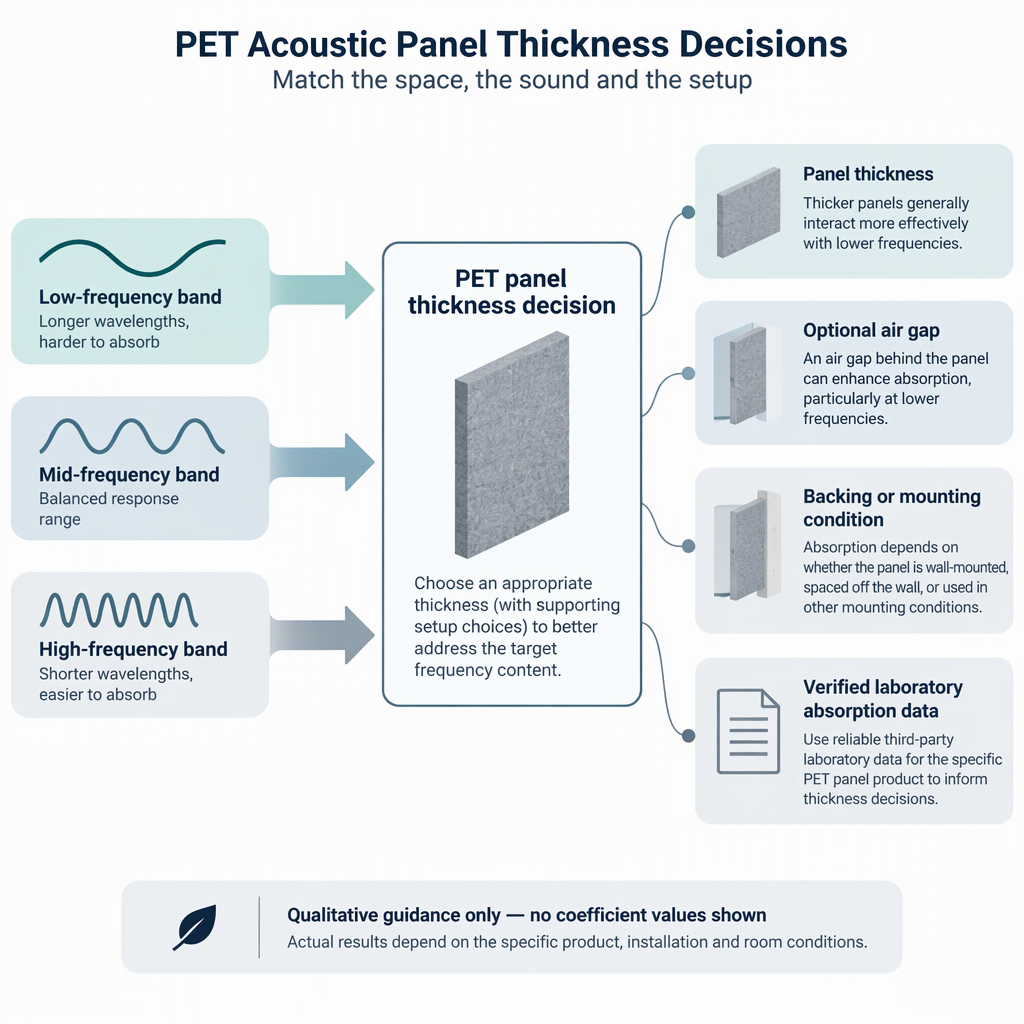
For specification work, treat thickness as one input in an absorption system. ASTM C423-23e1 is an active test method for sound absorption and sound absorption coefficients by the reverberation room method, covering absorptive material specimens as well as room and object absorption. Readers can verify the public scope on the ASTM C423 standard page.
A thicker PET acoustic panel may change the absorption curve, but the useful question is which octave bands improve under the tested mounting condition. Do not substitute a generic thickness rule for the actual coefficient table, specimen construction, and installation depth used for the project.
Absorption data describes how a material specimen absorbs sound energy in a room test context; it does not prove that the same panel blocks sound transmission through a wall, ceiling, door, or partition.
| Buyer question | Absorption selection | Isolation selection |
|---|---|---|
| What problem is being addressed? | Reducing reflected sound energy inside a room using absorption coefficients. | Reducing sound transmission between spaces, which requires separate assembly-level isolation evidence. |
| What data should be requested? | Octave-band or frequency-band absorption coefficients, test method, specimen size, and mounting condition. | Transmission-loss or assembly-rating evidence appropriate to the partition, not an absorption-only data sheet. |
| How should thickness be interpreted? | As one variable that may affect the absorption curve under the tested condition. | As insufficient by itself; isolation depends on the complete construction, sealing, mass, connections, and flanking paths. |
If the project brief asks for quieter speech inside a meeting room, absorption data may be relevant. If it asks to stop sound entering the next room, request isolation data for the whole assembly rather than relying on PET acoustic panel thickness alone.
Before specifying PET acoustic panel thickness, ask for frequency-band absorption coefficients, the test method, specimen and mounting description, and any practical-use notes that affect how laboratory results translate to the finished room.
ASTM C423-23e1 publicly describes a reverberation-room method for determining sound absorption and sound absorption coefficients. Its public page also cautions that laboratory coefficients should be used with judgment because practical sound fields and installed areas can differ from test conditions.
ColorBo’s PET product page lists Acoustic Series panels in 4 ft × 8 ft / 1220 × 2440 mm sheets, with 9 mm and 12 mm thicknesses and stated areal densities of 1900 g/sqm and 2300 g/sqm. Those listed options should still be matched to project absorption data and mounting conditions before they become a specification.
| Input to collect | Why it changes the thickness decision | What to ask for |
|---|---|---|
| Room use | Speech, hospitality, education, office, and public-area projects often emphasize different frequency bands and coverage areas. | Target reverberation or acoustic objective from the project acoustician. |
| Absorption coefficient data | Thickness should be judged by measured frequency-band behavior, not by thickness name alone. | Test method, coefficient table, specimen thickness, mounting condition, and sample construction. |
| Air layer or backing condition | Porous-absorber behavior can be influenced by air layer and layer depth, especially when low-frequency response is a concern. | Mounting detail showing direct fixing, stand-off depth, backing, cavity, and panel coverage. |
| Available sheet format | Panel size, thickness, and areal density affect layout planning, handling, and procurement quantities. | Confirmed sheet size, thickness, density, color, finish, and fabrication limits for the selected product. |
| Finish and detailing | Cut-outs, seams, frames, exposed edges, and decorative patterns can change the installed area and visible coverage. | Shop drawings, sample boards, edge details, and installation method. |
Laboratory absorption coefficients should be used with judgment because real sound fields and installed areas differ from the test condition. Layer thickness and air layer depth are also variables in porous or composite absorber behavior.
When panels are fixed directly to a backing, compare the project detail with the tested mounting before using the coefficient table in calculations.
An air layer can influence low-frequency behavior in porous or composite absorber systems, so the cavity depth should be part of the specification rather than an afterthought.
A coefficient measured on a specimen does not automatically define the finished room result; the exposed area and distribution of installed panels still matter.
Laminates, frames, backing boards, perforated fronts, and spacing details should be checked against the test specimen or separately assessed.
For design documents, state both the panel thickness and the mounting condition. A line item that only says “PET acoustic panel thickness” leaves too much interpretation for site substitution.
Before ordering, ask the supplier for the exact thickness, format, acoustic test data, mounting assumptions, and sample evidence needed to match the project room rather than a generic product description.
Published absorption coefficients are a starting point for design, but the finished room result depends on room geometry, installed area, mounting condition, sound field, and coordination with the wider acoustic design.
ASTM’s public significance-and-use note for C423 cautions that laboratory absorption coefficients should be used with judgment because practical sound fields and areas differ from test conditions. In procurement terms, this means a 9 mm or 12 mm listing should not be treated as a guaranteed room outcome without matching data and project review.
For spaces with critical acoustic requirements, ask the acoustician to use the selected coefficient data in a room model or calculation, then confirm samples and installation details before release for production.
The practical way to choose PET acoustic panel thickness is to begin with room use and target frequency bands, then verify the chosen thickness with test data and the intended mounting condition.
ColorBo’s PET page gives visible product-selection starting points such as 9 mm and 12 mm Acoustic Series sheet options. A specification should then add the absorption data, test method, mounting detail, sample review, and project acoustic calculation needed for the actual room.
Most buyer questions about PET acoustic panel thickness come down to frequency-band data, installation condition, and whether the project needs absorption, isolation, or both.
Not automatically. A thicker option should be judged by the frequency-band absorption data for the tested specimen and mounting condition, not by thickness alone.
Absorption data does not prove sound isolation. If the goal is to reduce transmission between rooms, ask for assembly-level isolation evidence rather than relying on a PET absorption panel specification.
ColorBo’s PET product page lists Acoustic Series full-size panels in 9 mm and 12 mm thicknesses, with stated sheet dimensions of 4 ft × 8 ft / 1220 × 2440 mm.
Octave-band or frequency-band data shows where absorption is occurring. That is more useful for design selection than a single broad summary when the room has specific speech, music, or noise-control goals.
An air layer can influence porous or composite absorber behavior, especially when lower-frequency response is part of the design discussion. The air gap should be specified and checked against the data used for selection.
Substitution should be reviewed against the same test method, coefficient bands, specimen construction, mounting detail, finish, and project acoustic target before approval.
A sample or mock-up is useful when finish, edge detailing, mounting method, coverage pattern, or room-critical acoustic requirements could affect the final installed result.