
Views: 0 Author: Site Editor Publish Time: 2026-07-07 Origin: Site


Choosing an acoustic wall covering by appearance alone can leave a room attractive but still echoing, while selecting the thickest available panel may consume space without solving the actual problem. Thickness affects which frequencies a porous panel can manage, but it works together with material structure, coverage, placement, mounting, and the sound sources in the room. A practical decision therefore starts with the room’s acoustic objective. The following approach helps specifiers compare thin decorative surfaces, general-purpose absorbers, and deeper treatment without confusing sound absorption with sound isolation.
The first question is not “Which thickness is standard?” but “What needs to change inside the room?” An acoustic wall covering is mainly intended to reduce reflected sound, shorten excessive reverberation, control flutter echo, and improve speech or program clarity. It should not automatically be treated as a soundproofing layer. Sound isolation between rooms usually depends on construction factors such as mass, airtightness, structural separation, and junction detailing.
Lightweight porous treatment can improve conditions within a room without preventing sound from passing through the building envelope. This distinction matters because thicker wall panels are sometimes selected in response to complaints about noise coming from an adjacent room. Increasing the depth of an absorber may improve in-room reflection control, but it does not replace a properly designed partition. The acoustic objective must be defined before panel thickness becomes a useful specification criterion.
Identify the dominant complaint before comparing thicknesses. A conference room may suffer from overlapping voices and hard-surface reflections. A restaurant may need lower overall reverberation across a large occupied area. A music room may sound muddy because low-frequency energy persists after higher frequencies have already decayed. These problems do not require the same acoustic wall covering depth, even when the rooms have similar floor areas.
Room size matters, but it should not be used as an isolated shortcut. A small studio with loudspeakers can require deeper treatment than a large reception area used mainly for conversation. Ceiling height, surface finishes, glazing, furniture, occupancy, loudspeaker output, and panel coverage all affect the result. Before selecting a product, document the room use, primary sound sources, reflective surfaces, available wall area, acceptable projection from the wall, and whether the objective is basic comfort or critical listening accuracy.
It is also useful to separate local reflection problems from room-wide reverberation. A small amount of treatment at first-reflection points may improve a recording or meeting position, while a reverberant public interior normally requires absorption distributed over a larger area. Increasing thickness cannot compensate indefinitely for insufficient coverage. The right acoustic wall covering specification balances depth and treated area rather than maximizing one variable.
Porous absorbers work when moving air associated with a sound wave enters the material and loses energy through friction within its fibers or pores. Higher-frequency wavelengths are shorter and can interact effectively with relatively shallow material. Lower-frequency wavelengths are longer, so useful absorption generally requires greater physical depth, an appropriate air space, or a purpose-designed low-frequency device. This is why two materials with similar surface appearance can behave differently when their thickness, density, airflow resistance, or backing arrangement changes.
A thin acoustic wall covering can be effective for decorative integration, flutter-echo reduction, and speech-dominated reflections. Increasing the material depth generally broadens useful absorption toward lower frequencies, but thickness alone does not guarantee better results. An excessively dense material can restrict airflow, while a very open material may not dissipate enough energy at the available depth. Facing materials, adhesives, rigid backings, perforations, and installation gaps can also alter the finished assembly.
Acoustic data should always be reviewed together with the test method and mounting condition. ASTM C423 evaluates sound absorption in a reverberation room through changes in sound-decay rate, while ISO 354 covers reverberation-room measurements for materials used as wall and ceiling treatments. Test results are most useful when the tested specimen resembles the planned installation. A rating obtained with an air space, frame, or special backing should not be applied automatically to the same material bonded directly to a solid wall.
NRC is a convenient single-number rating, but it should not be the only comparison point. It summarizes absorption across selected mid-frequency bands and does not show where performance rises or falls across the full spectrum. For speech spaces, the summary may be sufficient for an initial comparison. For music, cinema, mechanical noise, or other broad-frequency applications, octave-band or one-third-octave absorption data provides a more useful basis for judging thickness.
For projects requiring a slim decorative surface, ColorBo’s 4D PET Wall Panel has an 8mm profile and an embossed polyester-fiber structure. The panel measures 1200 × 2400mm and has an NRC range of 0.45–0.75. Its shallow depth can support decorative wall integration and reflection control where space is limited. It should still be selected according to the target frequencies and complete room treatment plan rather than treated as a replacement for deep bass absorption.
Different interiors produce different frequency patterns. Human speech, office equipment, dining noise, amplified music, and subwoofers do not place the same demand on an acoustic wall covering. The lowest important problem frequency often has more influence on required depth than the total floor area. The following framework is more reliable than assigning one standard thickness to every room of a similar size.
Room Condition | Main Concern | Thickness Direction | Additional Checks |
|---|---|---|---|
Offices and meeting rooms | Speech reflections and intelligibility | Thin to moderate treatment may be suitable | Coverage, wall position, ceiling absorption, and speech-band data |
Classrooms and public interiors | Reverberation across occupied zones | Balance moderate depth with broad coverage | Occupancy, ceiling height, durability, and fire requirements |
Multipurpose and media rooms | Speech plus music or playback | Consider deeper broadband panels | Frequency-band results, loudspeaker locations, and air gaps |
Studios and bass-heavy rooms | Low-frequency ringing and modal buildup | Use deeper specialized treatment | Corner devices, room modes, measurement, and available depth |
In speech-led rooms, large expanses of hard wall often cause rapid reflections that blur consonants and make group conversations tiring. A slim PET acoustic wall covering can be appropriate where wall projection must remain limited and the main objective is mid- and high-frequency control. In this situation, distribution is often more valuable than placing a few unusually thick panels in one location. Treating opposing hard surfaces, reflection paths near meeting positions, or long corridors can reduce repeated reflections more consistently.
The 9mm PET Felt Panel uses polyester fiber in a 2440 × 1220mm format. It has a 9mm thickness, a density of 1.9kg/m², and an NRC range of 0.45–0.75. Multiple color options allow the acoustic wall covering to become part of the interior finish instead of appearing as a separate technical addition. The slim format is particularly relevant where usable floor area, doors, displays, and wall-mounted services restrict panel projection.

Music playback, cinemas, rehearsal spaces, and recording rooms require a different decision. Thin panels may reduce brightness and flutter echo while leaving low-mid or bass decay largely unchanged. Adding more thin absorption can then make the room sound dull at higher frequencies but still uncontrolled at lower ones. Where the source includes strong low-frequency energy, deeper broadband panels, air-spaced assemblies, corner treatment, or tuned absorbers may be necessary.
Do not assume that a thicker acoustic wall covering automatically becomes a bass trap. A conventional porous wall panel can extend lower as depth increases, but very low frequencies may require more volume than the wall design can accept. In critical spaces, measurements or acoustic modeling can identify the problem bands before products are selected. Decorative thin panels and specialized low-frequency treatment can then be combined rather than forcing one material to perform both roles.
The finished assembly determines how the acoustic wall covering performs in practice. A panel bonded directly to concrete does not behave exactly like the same panel mounted on battens with an air space. Moving porous material away from a rigid boundary can improve absorption at some lower frequencies because the material interacts with sound where particle movement is greater. However, the benefit depends on the panel, gap depth, frequency range, and mounting system, so it should be supported by relevant test data rather than a universal rule.
Surface layers also matter. Paint, impermeable vinyl, dense leather, or an unsuitable fabric can restrict the movement of air into an absorbent core. A fabric-wrapped panel should use a facing compatible with the acoustic design, while decorative PET surfaces should not be covered later with coatings that close their structure unless the complete system has been evaluated. Adhesive coverage, edge frames, backing boards, and concealed services can produce additional differences between laboratory and field performance.
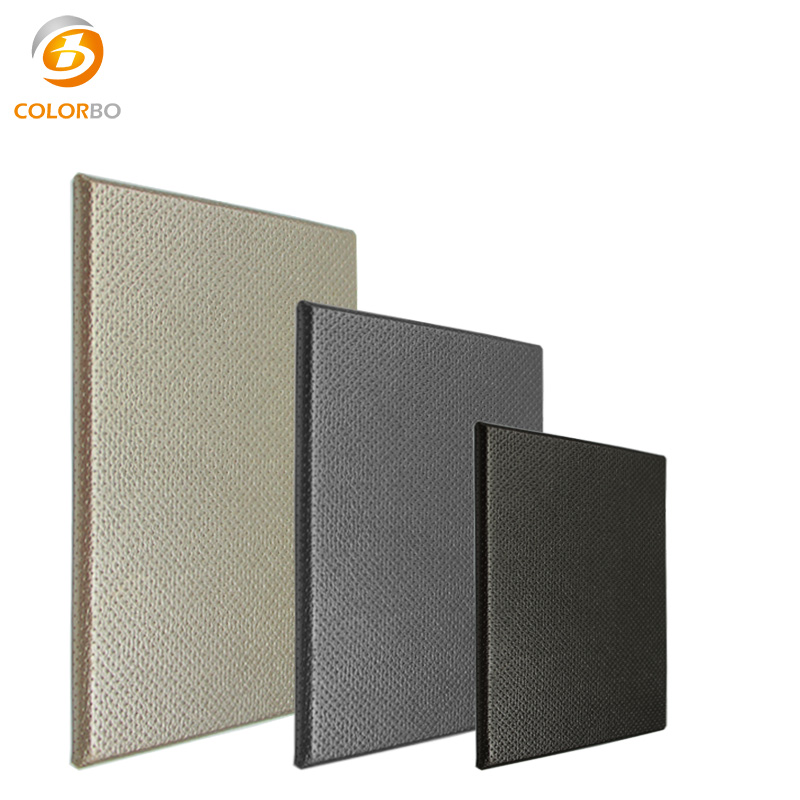
For projects needing greater depth or a textile appearance, ColorBo’s Fabric-Wrapped Acoustic Panels use a PET acoustic panel base with fabric or leather surface options. Available thicknesses are 9mm, 12mm, and 25mm, with corresponding density options of 1.9kg/m², 2.3kg/m², and 4kg/m². The panels measure 2400 × 1200mm and have an NRC range of 0.45–0.75. Multiple depth options make it possible to coordinate the acoustic wall covering with wall projection, edge detailing, visual proportions, and the intended absorption range.
Practical constraints must be reviewed alongside acoustic performance. A deeper panel may interfere with doors, switches, display systems, handrails, furniture, or circulation routes. Thin panels may be easier to cut around services but can reveal wall irregularities if installed as a continuous finish. High-contact areas may require protected edges, washable surfaces, or replaceable modules.
Fire classification, indoor-material requirements, fixing method, substrate compatibility, and maintenance access should be confirmed for the complete installed system rather than inferred from thickness alone. A panel may have suitable material characteristics but still require appropriate adhesives, frames, and installation details. Specifiers should also check whether test results apply to the same facing and backing proposed for the project. This avoids selecting a nominal thickness that performs differently after installation.
Visual design can also influence coverage. Repeating colors, grooves, embossed patterns, or varied panel dimensions may encourage the designer to treat a larger wall area without making the room look overly technical. This can be more effective than selecting a deep panel but limiting it to a small feature zone. The acoustic wall covering should therefore be developed together with the elevation design rather than added after the architectural layout is complete.
A clear workflow prevents decisions based on a single number. It also makes different acoustic wall covering options easier to compare because each one is evaluated against the same room objective. The process should connect acoustic requirements with installation, appearance, and maintenance rather than treating thickness as an independent product feature. The following steps provide a practical structure for early selection and final specification.
Define the required outcome. State whether the project needs clearer speech, reduced general reverberation, controlled early reflections, improved recording accuracy, or lower-frequency management. Avoid vague objectives such as “make the room quieter,” because that phrase can refer to absorption, isolation, background noise, or equipment noise.
Identify the sound spectrum. Note whether the space is dominated by conversation, machinery, music, amplified events, or subwoofers. The lowest important problem frequency usually has more influence on the required acoustic wall covering depth than the room’s floor area.
Estimate the necessary coverage. Review exposed concrete, glass, gypsum, timber, flooring, ceilings, furniture, and occupancy. A moderately thick acoustic wall covering installed across sufficient reflective area may outperform a deeper product installed too sparingly.
Compare equivalent acoustic data. Check material thickness, specimen size, mounting condition, air gap, facing, and frequency-band results. Do not compare a direct-wall NRC rating with another result obtained from a framed or air-spaced assembly without considering the mounting difference.
Coordinate the installed depth. Include the panel, frame, air space, adhesive, clips, or battens when calculating projection. The nominal material thickness may be smaller than the total space consumed by the finished acoustic wall covering system.
Verify project requirements. Confirm fire performance, environmental documentation, color consistency, edge durability, cleaning method, cutting details, substrate preparation, and replacement procedures before approving the final configuration.
Test uncertain applications. A sample installation or room-acoustic assessment can reveal whether the selected thickness and coverage provide enough improvement. Testing is particularly valuable in studios, auditoriums, large public interiors, and rooms with unusual geometry.
Common warning signs include specifications based only on NRC, claims that thin decorative panels will soundproof adjoining rooms, performance data without a stated mounting method, and proposals that ignore coverage. Another concern is selecting several thicknesses for visual variety without checking whether their combined response remains balanced. A successful acoustic wall covering schedule should explain why each depth is used, where it will be installed, and how it contributes to the complete treatment strategy.
The right acoustic wall covering thickness addresses the room’s dominant reflections without creating unnecessary wall projection or leaving important frequency problems untreated. Start with the sound source and required outcome, then compare coverage, frequency-band performance, mounting, facing, air space, and installation constraints. Shanghai ColorBo Industrial Development Co., Ltd. is an acoustic-material manufacturer and supplier offering thin PET finishes and multi-thickness panel options. These products can support different decorative and room-acoustic strategies when selected as part of a complete, application-specific assembly.
A: No. Greater depth can broaden frequency absorption, but unnecessary thickness increases projection and cost. Room use, coverage, material structure, mounting, and target frequencies must also be considered.
A: They can support speech-reflection and reverberation control when correctly distributed, but suitability depends on acoustic data, required coverage, existing finishes, room volume, and ceiling conditions.
A: Acoustic covering mainly absorbs reflections within the treated room. Blocking transmission normally requires construction measures involving mass, airtightness, decoupling, doors, glazing, and carefully detailed junctions.
A: An air gap can improve performance at some lower frequencies, but results depend on panel depth, material, gap size, and mounting. Use data representing the planned assembly.
A: NRC is useful for initial comparison, especially in speech spaces, but frequency-band absorption data gives a clearer picture of performance across low, middle, and high frequencies.
A: Required coverage depends on room volume, existing finishes, occupancy, acoustic targets, and panel performance. Calculation or measurement is more reliable than applying one percentage to every room.