



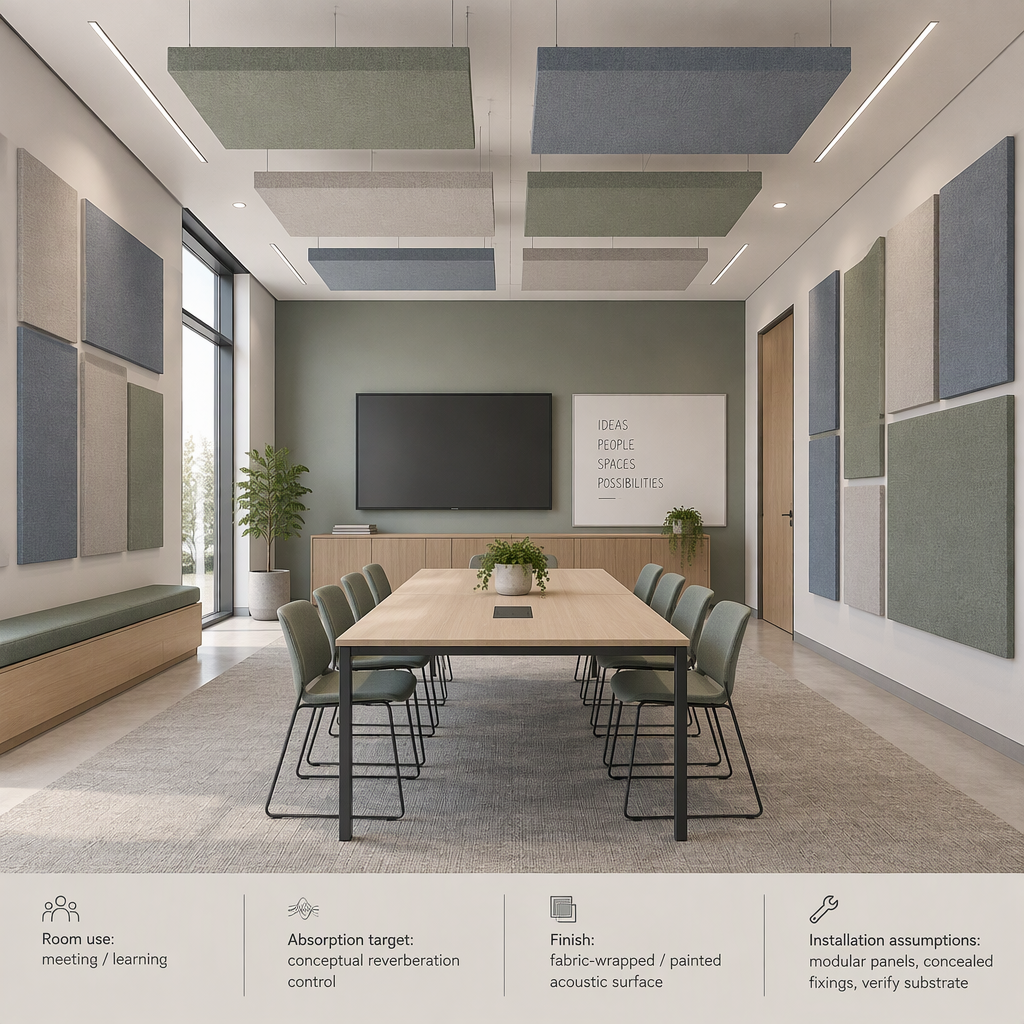
Start With the Specification Items That Control the Decision
Begin with how the room will be used and the listening conditions it must support. Then define the acoustic panel evidence needed to review absorption performance, including the test method and reporting basis.
A custom acoustic panel specification should make the buyer’s decision comparable before the supplier prepares a quote. Instead of asking only for a size, color, and price, give the supplier the application context, the expected acoustic role, the mounting assumptions, and the documents that must be returned with the offer.
| Specification item | What to define | Why it matters before RFQ |
|---|---|---|
| Room use | Identify whether the space is designed for speech, teaching, meeting, hospitality, open-office work, or another listening condition. | Room purpose affects the acoustic design context and the information the designer should provide. |
| Acoustic role | State whether the panel is being selected for sound absorption and ask for absorption-test evidence when that is the design need. | Absorption products are reviewed through sound absorptive properties, not by assuming they solve every noise-control problem. |
| Mounting basis | Ask the supplier to state how the tested sample was mounted and how the project installation will be mounted. | Absorption reporting is tied to the way products are tested and presented in the report. |
| Material and market compliance | For U.S.-bound projects, identify whether any backing board or finished good contains hardwood plywood, MDF, particleboard, or other regulated composite wood products. | Those product categories can fall under EPA TSCA Title VI formaldehyde requirements when sold, supplied, manufactured, or imported into the United States. |
Separate Sound Absorption From Sound Isolation
Specify absorption with sound-absorption evidence such as ASTM C423 reporting terms, and treat sound isolation as a separate assembly-level requirement rather than a promise made by a decorative panel alone.
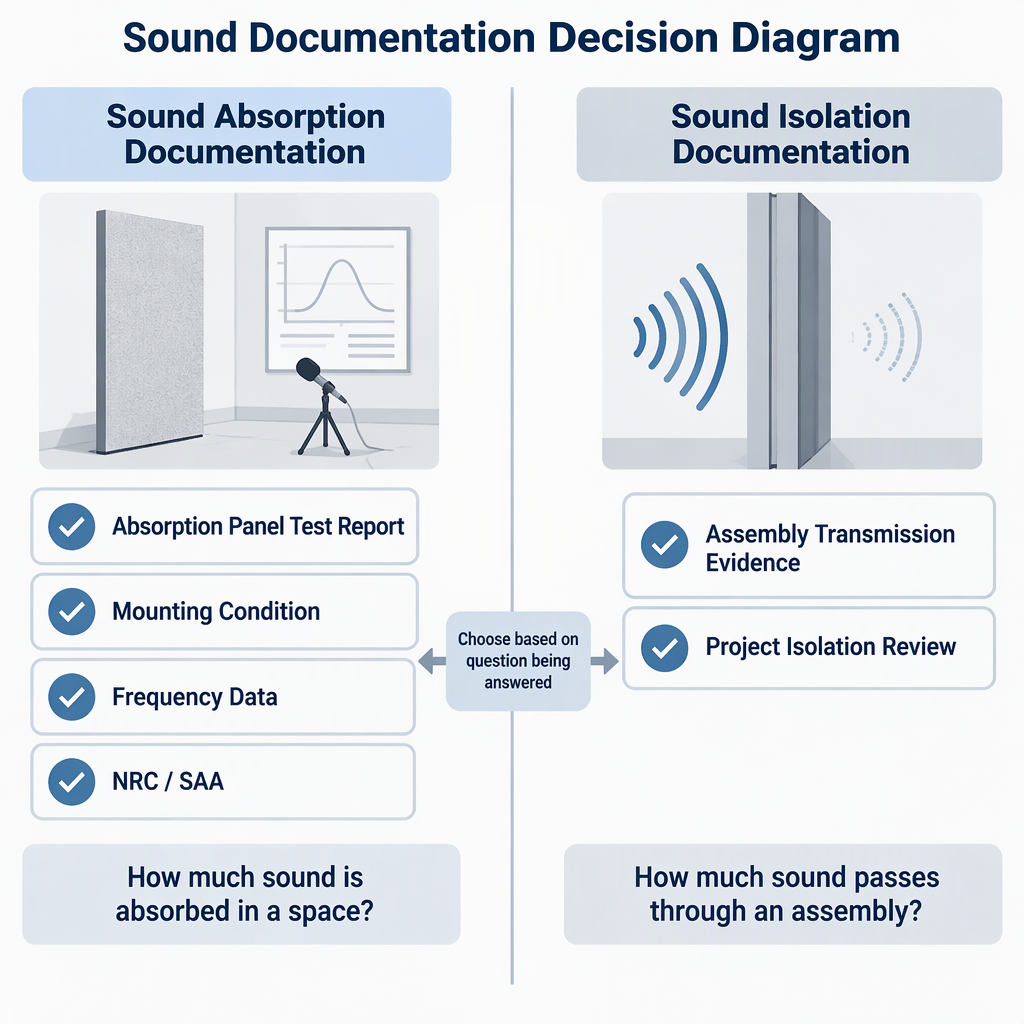
ASTM C423 is described as a reverberation-room method for measuring sound absorptive properties of products, with NRC and SAA reported for extended plane surfaces and absorption per unit used for individual objects in some cases.
| Decision area | Specify for absorption | Do not confuse with |
|---|---|---|
| Design intent | Reducing reflected sound energy inside a room by selecting absorptive surfaces or objects. | Blocking sound transmission through walls, doors, floors, ceilings, or other complete assemblies. |
| Evidence to request | A sound-absorption test report that states the method, frequency data, NRC or SAA where applicable, and mounting condition. | Unrelated claims that a panel alone will deliver room-to-room isolation without an assembly test or project-specific acoustic review. |
| Specification wording | “Provide absorption test data for the proposed panel construction and mounting condition.” | “Provide soundproofing” without defining the partition, penetrations, flanking paths, or isolation metric. |
Define Room Use, Occupancy, and Acoustic Intent
Give the supplier the room function, listening priority, occupancy pattern, and design constraints so the panel proposal is tied to the space, not just to a catalog finish.
The Acoustical Society of America publishes classroom acoustics booklets, including a booklet for architects as a companion to ANSI/ASA S12.60 Parts 1 and 2, which reinforces that room use and listening conditions are part of the acoustic design context.
- State the main activity: teaching, presentation, conferencing, dining, reception, office work, rehearsal, or mixed use.
- Describe the critical listener position, such as students, meeting participants, guests, staff, performers, or remote-conference users.
- Provide reflected-ceiling plans, elevations, furniture layouts, and areas where panels are permitted or prohibited.
- Identify visible design constraints, including edge detail, color matching, fabric direction, panel joints, removable access panels, and coordination with lighting or sprinklers.
- List environmental and maintenance expectations, such as public-contact zones, cleaning approach, impact exposure, and whether panels must be demountable.
Request Test Reports With Mounting and Frequency Context
Before approving a custom panel, request an acoustic test report that states the test method, reported absorption values, sample description, and mounting condition.
For absorption evidence, ask whether the report follows ASTM C423 sound absorption testing and whether it reports NRC, SAA, frequency-band coefficients, or absorption per unit as appropriate for the product type.
NRC and SAA can help with selection, but the report context matters. A value from one thickness, facing, airspace, or mounting condition should not be treated as proof for a different custom construction unless the supplier can document the relationship.
- Request the test method name and the edition or report date shown on the document.
- Request the tested sample construction, thickness, facing, backing, edge condition, and tested mounting method.
- Ask for octave-band or frequency-band absorption data when the acoustic consultant needs more than a single-number rating.
- Ask the supplier to identify which report applies to the exact proposed panel and which parts of the quote are custom changes.
- Keep fire, emissions, impact, and cleaning evidence as separate document requests rather than assuming they are included in the acoustic report.
Specify Materials, Finish, and Compliance Documents
List every material layer and destination-market requirement, especially when the panel includes composite wood components for a U.S.-bound project.
| Item to specify | Buyer check | Document to request |
|---|---|---|
| Core and backing | Identify core, facing, backing board, adhesive, and frame materials by type rather than by appearance only. | Material data sheet and construction drawing for the offered panel. |
| Composite wood content | For the United States, check whether the panel or finished good contains hardwood plywood, MDF, particleboard, or covered composite wood products. | If applicable, request documentation aligned with the EPA formaldehyde emission standards for composite wood products. |
| Finish | Define color, texture, perforation or fabric direction, edge detail, exposed hardware, and acceptable visual tolerances. | Finish sample, control sample approval process, and maintenance instructions. |
| Project compliance | Identify fire, emissions, hygiene, sustainability, or local building requirements from the project specification. | Current project-relevant test reports or declarations from the supplier, reviewed by the design professional or authority having jurisdiction where required. |
Lock Down Installation Conditions Before RFQ
The RFQ should state how and where panels will be mounted because the tested mounting basis and the project installation need to be comparable.
- Mark panel locations on drawings and separate wall panels, ceiling clouds, baffles, suspended elements, and specialty shapes.
- State the intended mounting method and compare it with the mounting condition shown in the absorption report.
- Define substrate type, access zones, penetrations, joint alignment, panel size limits, and coordination with lights, diffusers, sprinklers, signage, and access panels.
- Ask who supplies hardware, templates, shop drawings, packing marks, and installation instructions.
- For retrofit work near powered building equipment, require installers to switch off and disconnect the relevant power source before manual access to equipment zones, then follow the equipment manual and site safety rules.
- Set approval hold points for samples, shop drawings, mockups, and final acceptance so visual and acoustic assumptions are reviewed before mass production.
Use an RFQ Checklist to Keep Supplier Quotes Comparable
A comparable RFQ asks every supplier for the same acoustic report basis and mounting assumptions. It also asks for market-specific material compliance documents when regulated materials may be included.
- Project name, country or region of installation, room type, drawings, reflected-ceiling plan, elevations, and panel schedule.
- Room-use description and the listening or speech condition the design team is trying to support.
- Required absorption evidence: test method, frequency data, NRC or SAA where applicable, sample construction, and mounting condition.
- Panel dimensions, thickness target, edge detail, facing, color, pattern, backing, hardware visibility, and sample approval process.
- Composite-wood declaration and TSCA Title VI documentation when the product is U.S.-bound and includes covered hardwood plywood, MDF, particleboard, or finished goods containing those products.
- Separate requests for fire, emissions, cleaning, durability, packaging, labeling, spare panels, and installation instructions.
- Acceptance criteria for submittals, mockups, production samples, delivery labeling, site handling, and final inspection.
Next step: attach this checklist to the RFQ package and ask each supplier to return the same document set, so acoustic designers, decoration contractors, and material buyers can compare scope rather than interpreting different proposal formats.
Conclusion
A useful custom acoustic panel specification connects absorption evidence to the proposed construction and mounting condition. It also starts from room use and listening intent.
- Define the room, the acoustic purpose, and the visible design constraints before discussing price.
- Keep absorption data separate from isolation requirements and ask for the test-report basis.
- Check destination-market material rules when composite wood may be part of the panel or finished good.
FAQs About Custom Acoustic Panel Specifications
These questions help buyers close common gaps before issuing a custom acoustic panel RFQ.
What should a custom acoustic panel specification include?
Include room use, acoustic intent, panel size and finish, construction layers, mounting basis, test-report requirements, material compliance documents, installation responsibilities, sample approvals, packing, and acceptance criteria.
Is sound absorption the same as sound isolation?
No. Absorption selection concerns sound absorptive properties measured for a product or surface, while isolation depends on the performance of a complete building assembly and should be specified separately.
Should I specify only an NRC value?
NRC can be useful, but it should not stand alone. Ask for the full report context, including the method, sample construction, mounting condition, and frequency data when the acoustic design requires it.
Why does room use matter for panel selection?
Room use matters because speech, teaching, meeting, hospitality, and work settings create different listening priorities and design constraints.
When should I ask about formaldehyde rules?
For U.S.-bound projects, ask when a panel or finished good contains hardwood plywood, MDF, particleboard, or other covered composite wood products subject to EPA TSCA Title VI requirements.
What installation details should be fixed before pricing?
Fix the mounting method, substrate, panel layout, hardware responsibility, tolerances, coordination with building services, sample approval route, and any site access restrictions before requesting final pricing.
What if the proposed custom finish differs from the tested sample?
Ask the supplier to explain which acoustic report applies to the proposed construction and whether the changed finish, facing, thickness, backing, or mounting condition needs additional review.


