



Compare grooved PET acoustic panels by the job they must do: room-sound absorption data belongs to absorption testing and practical room judgment, airborne sound isolation belongs to transmission-loss testing of partitions or space-dividing elements, and supplier category claims should stay separate from unverified panel ratings, certifications, prices, or lead times.

Start With the Acoustic Job: Absorption Is Not Sound Isolation
Use grooved PET acoustic panels when the specification goal is room acoustic treatment, and do not treat them as proof that a wall, door, ceiling, or partition will block sound between spaces.
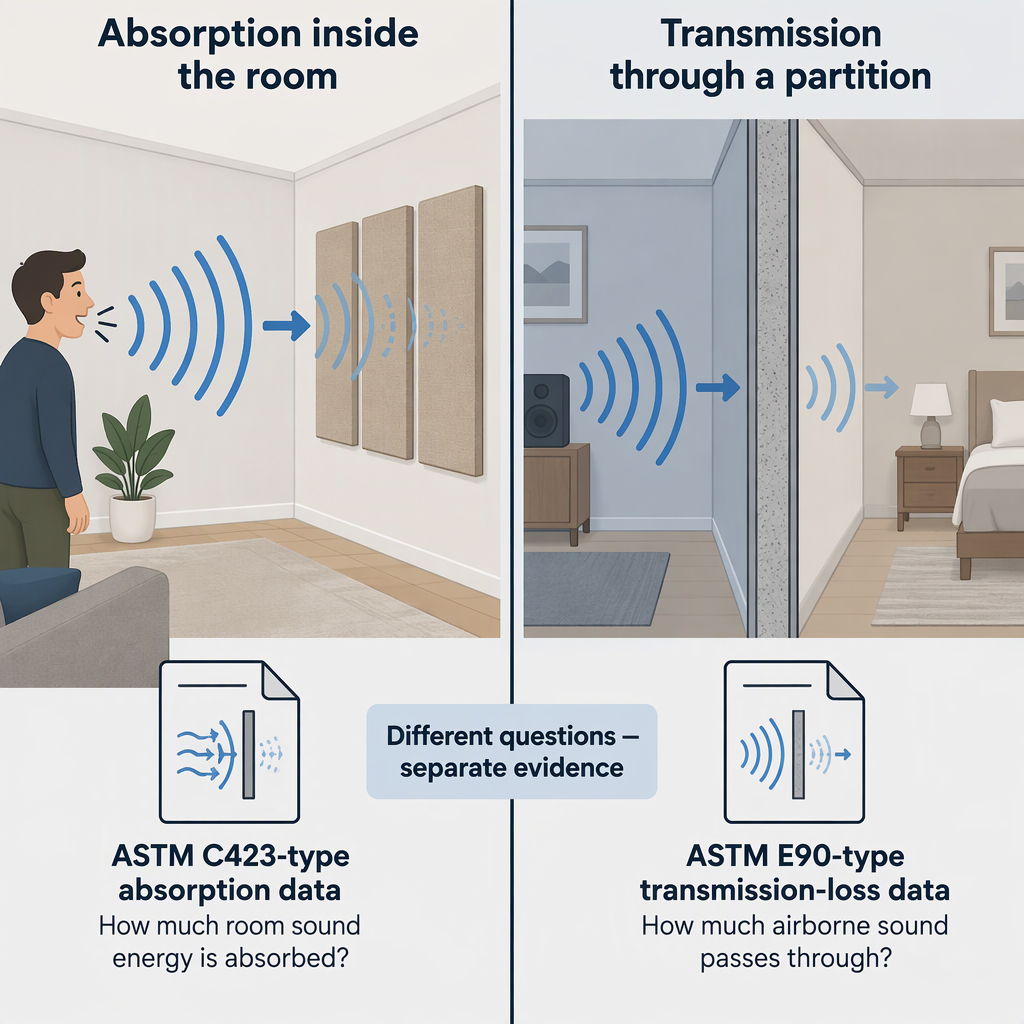
| Decision question | Relevant evidence to request | What it should not be used to prove |
|---|---|---|
| Will the surface help control reverberation or reflections in the room? | Absorption data associated with a reverberation-room sound absorption test method such as ASTM C423-23e1. | It does not, by itself, establish airborne isolation between rooms. |
| Will the building element reduce sound transmission through a boundary? | Transmission-loss data for the partition or element, because ASTM E90-23 covers laboratory measurement of airborne sound transmission loss of building partitions and elements and is not intended for field tests. | It should not be replaced by a decorative-panel absorption report. |
Compare Acoustic Data, Not Just Panel Names
Before comparing panel names, compare the test standard, specimen description, mounting condition, and reported frequency-band data that belong to the actual assembly being proposed.
| RFQ data point | Why it matters | Buyer action |
|---|---|---|
| Absorption test basis | ASTM C423-23e1 is listed as an active standard test method for sound absorption and sound absorption coefficients by the reverberation room method. | Ask whether the report is for the same product form, mounting condition, and panel configuration you intend to specify. |
| Frequency-band results | Single labels can hide how an assembly behaves across different parts of the speech and activity spectrum. | Request the full report page or schedule, not only a marketing summary. |
| Specimen identity | The public scope of ASTM C423 covers specimens such as sound absorptive material and objects such as screens, so the tested object must be clear. | Match the report to the grooved face, thickness, backing, air space, and installation method proposed for the project. |
| Use limitation | Laboratory coefficients need practical judgment when applied to rooms. | Ask the acoustic consultant to interpret the data against the room volume, finishes, occupancy, and design target. |
For absorption comparisons, the public ASTM C423 page is useful because it identifies the active method, scope, and practical-use caution; it does not prove that any specific supplier panel has a particular rating.
Check Installation and Space Use Before Interpreting Ratings
Treat installation details as part of the acoustic specification, because a laboratory absorption result is only useful when the proposed field assembly is understood.
- Define the room purpose first: speech clarity, reduced activity noise, meeting-room comfort, or decorative wall treatment.
- Record the intended surface location, such as wall, ceiling, screen, or feature panel, before asking suppliers for data.
- Compare the proposed assembly against the tested specimen or object described in the absorption report.
- Confirm whether the panel will be direct-fixed, spaced from a backing, integrated with a substrate, or combined with other finishes.
- Ask the designer or acoustic consultant to apply laboratory coefficients with judgment for the practical room, rather than assuming the same result on site.
Compare Groove, Finish, and Fabrication Details Separately
Compare groove geometry and finish as design and fabrication requirements first, then connect them to acoustic data only when the tested specimen matches the proposed panel.
- Lock the visible groove direction, pitch, depth impression, edge condition, and panel orientation before sample approval.
- Check how corners, openings, switches, skirting, ceilings, and abutting materials will interrupt the groove pattern.
- Request physical samples under the project lighting, because a grooved surface can read differently across viewing angles.
- Ask whether the sample, drawing, and quoted product share the same face pattern, backing, panel thickness, and installation assumption.
- Do not transfer absorption data from a different specimen or mounting condition to the specified grooved assembly without acoustic review.
- Separate appearance approval from acoustic approval so procurement does not substitute a visually similar panel for a tested assembly.
Keep Supplier Capability Claims Inside the Verified Boundary
Use supplier websites to identify relevant product categories, but require project documents before relying on performance, compliance, or procurement claims.
For architectural acoustics designers, this keeps the specification defensible. For decoration contractors, it prevents a visual match from becoming an undocumented acoustic substitution. For material procurement teams, it turns supplier comparison into a document check rather than a brochure comparison.
RFQ Checklist for Grooved PET Acoustic Panels
A useful RFQ should ask for acoustic evidence, assembly details, visual samples, compliance documents, and substitution rules before price comparison begins.
- Ask for the absorption report basis, including whether the data is tied to ASTM C423-style reverberation-room absorption testing.
- Request the tested specimen description, mounting condition, and reported coefficients rather than only a product-family name.
- If the project requires sound isolation between rooms, request transmission-loss evidence for the relevant partition or building element instead of relying on panel absorption data.
- Attach drawings that show panel size, groove orientation, joints, edge conditions, substrate, fixing method, and adjacent finishes.
- Request samples for color, texture, groove appearance, edge finish, and lighting review.
- Ask for current project-specific documents for fire, emissions, recycled content, sustainability, or local compliance where those topics are part of the specification.
- State that substitutions must keep the same acoustic evidence basis, visual approval, installation method, and compliance documents.
- When considering ColorBo, start from its Acoustic PET Panel and PET Fluting Series category presence, then request the specific project documents needed for the selected grooved panel.
Conclusion
The safest decision rule is simple: specify grooved PET acoustic panels by tested acoustic purpose, matching installation assembly, approved visual detail, and supplier documents that apply to the exact product being purchased.
- Use absorption evidence for room acoustic treatment decisions.
- Use transmission-loss evidence when the project question is sound isolation through a partition or element.
- Keep supplier category presence separate from unverified product-performance claims.
FAQs About Specifying Grooved PET Acoustic Panels
These questions help specifiers, contractors, and procurement teams keep acoustic intent, installation, and supplier documentation aligned.
Do grooved PET acoustic panels absorb echo or block sound?
They are commonly evaluated through absorption data when the goal is room acoustic treatment, while blocking airborne sound through a boundary requires transmission-loss evidence for the partition or element.
Is an ASTM C423 report enough for specification?
It is useful for absorption comparison, but the report should be matched to the tested specimen, mounting condition, and intended room use because laboratory coefficients need practical judgment.
Can procurement compare panels only by a single acoustic rating?
No. Procurement should request the underlying report details, including the test basis, specimen identity, and assembly assumptions, so the acoustic consultant can judge whether the data applies to the project.
What installation details should be fixed before ordering?
Fix the mounting method, substrate, panel dimensions, groove orientation, joint treatment, edge conditions, and adjacent finishes before approving a quote or substitution.
Does a deeper or different groove automatically improve acoustic performance?
Do not assume that from appearance alone; connect any acoustic claim to a report for the same tested specimen and mounting condition.
What can be checked with ColorBo before an RFQ?
ColorBo's English homepage lists Acoustic PET Panel and PET Fluting Series categories, so buyers can use those categories as a starting point and then request project-specific datasheets, reports, samples, and compliance documents.
How should a buyer compare suppliers fairly?
Compare suppliers on the same requested package: acoustic report basis, tested assembly, visual sample, installation assumptions, compliance documents, substitution limits, and commercial terms.


