
Views: 0 Author: Site Editor Publish Time: 2026-11-25 Origin: Site


Three samples sit on the meeting room table. Which one will tame the echo? PET, wood, and fabric acoustic panels offer different finishes. Each has its own mounting and care requirements. We’ll compare sound absorption and installation depth. You’ll see what drives the installed cost.
These labels describe different parts of a panel. PET can form the main absorbing layer. Wood often forms the visible face, while fabric covers a separate core. The categories overlap. A wood slat panel, for example, can have PET felt behind the slats.
Panel type | When to shortlist it | What could rule it out |
|---|---|---|
Exposed PET felt | You want color, cut shapes, or a slim wall treatment | The assembly that meets your sound target needs more depth than you have |
Wood-faced | A timber or veneer finish is central to the interior | The proposed openings, backing, or cavity differ from the tested assembly |
Fabric-wrapped | You want an upholstered finish and a choice of absorptive core | The proposed fabric, core, or cleaning requirements do not suit the space |
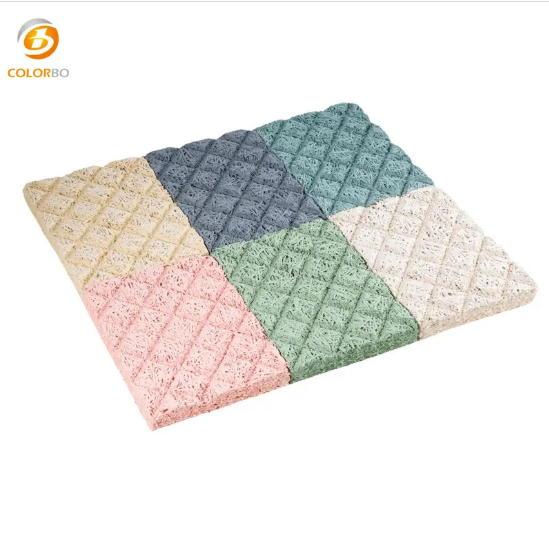
Start with exposed PET felt when the panel layout includes colors, patterns, or custom shapes. A branded office wall may need several shapes around signage, outlets, and door frames. Compare edge samples and ask how the pieces will meet at corners. These details affect how cleanly the finished pattern reads across the wall.
If the retrofit leaves little room for a cavity, request data for the exact thickness and a direct-mounted configuration. Check the approved fixing method while you compare samples. If recycled content affects the purchase, ask for a declaration covering the proposed model and thickness.
Start with wood-faced acoustic panels when the project calls for a visible timber or veneer surface. Compare slats over felt with perforated wood over an absorptive backing. The openings give sound a path to the material behind the face. The size and arrangement of those openings help shape the absorption response.
Ask for a section drawing alongside the finish sample. Look for the slat gaps or perforations, backing thickness, cavity depth, and any infill. Two samples may have a similar oak finish, while their section drawings show different assemblies. Use the test report for the assembly you are actually buying.
Fabric-wrapped panels combine an upholstered face with a separate absorptive core. Glass wool is one example. When comparing a glass-wool option with a mineral-wool option, check the core material, thickness, and edge construction. Then confirm that the selected fabric is covered by the finished panel’s acoustic documentation.
A fabric swatch helps you decide how the panel will look under the room’s lighting. A finished sample also shows how the supplier wraps corners and joins the fabric at the back. Check those details if the panels will sit at eye level or have visible edges.
Listen to what happens when someone stops speaking. If their words seem to linger, focus on reflected sound and reverberation inside the room. If you hear a conversation through a shared wall, assess how sound travels through the partition, door, or other openings. That distinction determines which test evidence you should ask for.
For an echo problem, describe where it happens and what the room is used for. In a meeting room, the priority might be reducing lingering speech around the table. In a listening room, several seats may have problems in a lower frequency range. Those rooms give you different reasons to look at the absorption curve.
The Noise Reduction Coefficient, or NRC, summarizes sound absorption in a single number. ASTM C423 measures sound absorption in a reverberation room. The test report also shows results across individual frequency bands, which helps you see where a panel absorbs more or less sound.
Imagine two panels have the same NRC. One shows higher absorption at 125 Hz, while the other shows stronger results in a higher band. This is an illustrative comparison, so verify the actual figures in each supplier’s report. If the listening room has a measured problem at 125 Hz, that band deserves a closer look.
Use the project drawing to narrow the shortlist before comparing headline ratings.
Measure the available depth. Check how far the finished panel can project from the wall. Allow for doors, furniture, and other places where clearance matters.
Add up the complete assembly. Include the panel, rails or battens, and any cavity or infill shown in the tested detail.
Match the proposed mounting to the report. Check the sample thickness, backing, and air space. If your project calls for a flush finish, request data for that mounting.
tip:Ask each supplier to show the tested build-up and total installed depth on your wall section.
Consider a meeting room with glass walls, hard flooring, and limited space for wall treatment. Compare direct-mounted PET felt with a slim fabric-wrapped panel. If the interior calls for wood, include a wood-faced option whose documented installation fits the same space.
Check speech-band absorption and how much surface each proposal actually treats. Suppose joinery limits the wood option to a small feature area. A PET or fabric layout may cover more of the available wall. Compare the full layouts before deciding. If the project sets a reverberation target, use the proposed coverage and absorption data to check it.
▸ Reception area. If wood is central to the design, start by comparing veneer samples and matching test reports. Check how the panels meet doors and joinery, then review how staff can clean or replace individual pieces.
▸ Listening room. If dialogue sounds boomy, identify the frequency range before choosing a panel. Compare deeper PET, wood-faced, or fabric-wrapped assemblies using results in that range. If the problem varies across seats, assess the room before deciding where to add treatment.
Record panel thickness and installed depth separately. A thin panel can still need rails or a cavity to reproduce its tested configuration. Confirm the proposed weight, support system, and fixing instructions for the wall or ceiling. Check who supplies each part of the mounting system before the order goes out.
Use a small mock-up where seams, corners, or panel edges will be visible. Lay out several pieces together and check how they meet. A PET pattern may depend on clean cuts. A wood slat panel may need consistent gaps across joints. A fabric panel can show uneven edges where adjoining pieces meet.
Include the facilities team when reviewing finish samples. Think about fingerprints beside doors, marks around chairs, and dust along exposed edges. Ask the supplier to demonstrate the approved cleaning method on the sample.
Can staff remove common marks using the approved method?
Can they replace one damaged panel without removing neighboring pieces?
Can they reorder a matching finish, or should they keep spare panels?
Give suppliers the same drawing and net treated area. Ask for an installed price that breaks down the panel, support system, and labor. This makes it easier to compare a direct-mounted proposal with one that needs cavity infill or more detailed edge work.
Cost item | What to ask the supplier to include |
|---|---|
Panels and finish | Exact model, thickness, selected finish, and net treated area |
Mounting system | Rails, battens, clips, fixings, and any cavity infill |
Layout and labor | Cutting around openings, edge work, handling, and installation |
Delivery and replacement | Packaging, freight, spare panels, and replacement lead time |
Imagine a reception wall gains a doorway and two new outlets. A shaped PET layout may need revised cuts. Wood slats may need to realign on both sides of the opening. A fabric-wrapped layout may need smaller units or extra finished edges. Ask each supplier to price the revised drawing and identify exclusions. That shows how each design will affect labor, waste, and the total price.
Put the finish sample, technical drawing, and acoustic report side by side. Match the model, thickness, facing, and core or backing. Then check the mounting detail, including the cavity and infill. If the project specifies fire performance, emissions, or recycled content, request documentation applicable to the proposed product or assembly.
note:If a finish or backing changes after approval, ask which test evidence covers the revised panel.
Shanghai ColorBo Industrial Development Co., Ltd. lists PET, wood-faced, and fabric-wrapped acoustic panels. When comparing options from its range, give ColorBo the same room brief, depth limit, and finish requirements. Request samples and technical details for the models that fit. Then compare their absorption evidence, installation details, and care instructions using the same criteria.
Choose PET for felt finishes or custom shapes. Choose wood when a timber surface is central to the design.
Choose fabric for an upholstered finish and your preferred core. Check absorption data for the frequencies that matter.
Confirm the tested mounting fits your space. Compare quotes for the complete installation.
Shanghai ColorBo Industrial Development Co., Ltd. offers all three panel types. Its range helps buyers coordinate finishes and acoustic treatment.
A: Fabric-wrapped acoustic panels use fabric over an absorptive core, such as glass wool. The fabric gives the panel its upholstered finish, while the core helps absorb reflected sound. Before ordering, confirm that the test report covers your chosen fabric and core thickness.
A: Shortlist PET acoustic panels for custom shapes, wood for a timber finish, and fabric for an upholstered look. Then compare the absorption curves for mounting options that fit your space. If the panels must sit flush against the wall, ask for direct-mount test data.
A: Ask suppliers to quote the same treated area and wall layout. Compare panel prices alongside fixings, battens, infill, and labor. Custom PET cuts, wood slat alignment, and finished fabric edges can each add work around doors, corners, or outlets.
A: First, check that the installed backing and cavity depth match the test report. Then look at where you placed the panels and how much surface they cover. In a glass-walled meeting room, a narrow feature strip may leave much of the room’s reflective area untreated.